
How to Clear Wagering Requirements: A Low-Volatility Strategy Guide
Unlock your casino bonus with our low-volatility strategy. Learn to clear wagering requirements using high RTP slots and smart risk management to keep your winnings.

There is no feeling quite like landing a big win with a casino bonus, only to realize your funds are locked behind a massive number: the wagering requirement. It is the hurdle that separates “bonus money” from real, withdrawable cash. (If you want the fundamentals first, see our guide to casino odds, RTP & house edge.)

Many players approach this phase aggressively, hoping to hit another jackpot to clear the hurdle. However, the math suggests a different approach. If your goal is to walk away with profit, the most statistically sound method is the Low-Volatility Strategy. (Not sure what volatility means in practice? Read game volatility & variance explained.)
This guide will strip away the jargon and show you exactly how to use low-volatility gameplay to grind down wagering requirements (WR) while protecting your balance.
The Math Behind the Grind
Before executing the strategy, you must understand the mechanics working against you. Casinos are businesses, and wagering requirements are designed to give the “House Edge” enough time to eat away at your bonus balance before you can withdraw it. (For a deeper look into the mechanics, see how online casinos really work: RNGs, algorithms, and the house edge.)
What are Wagering Requirements?
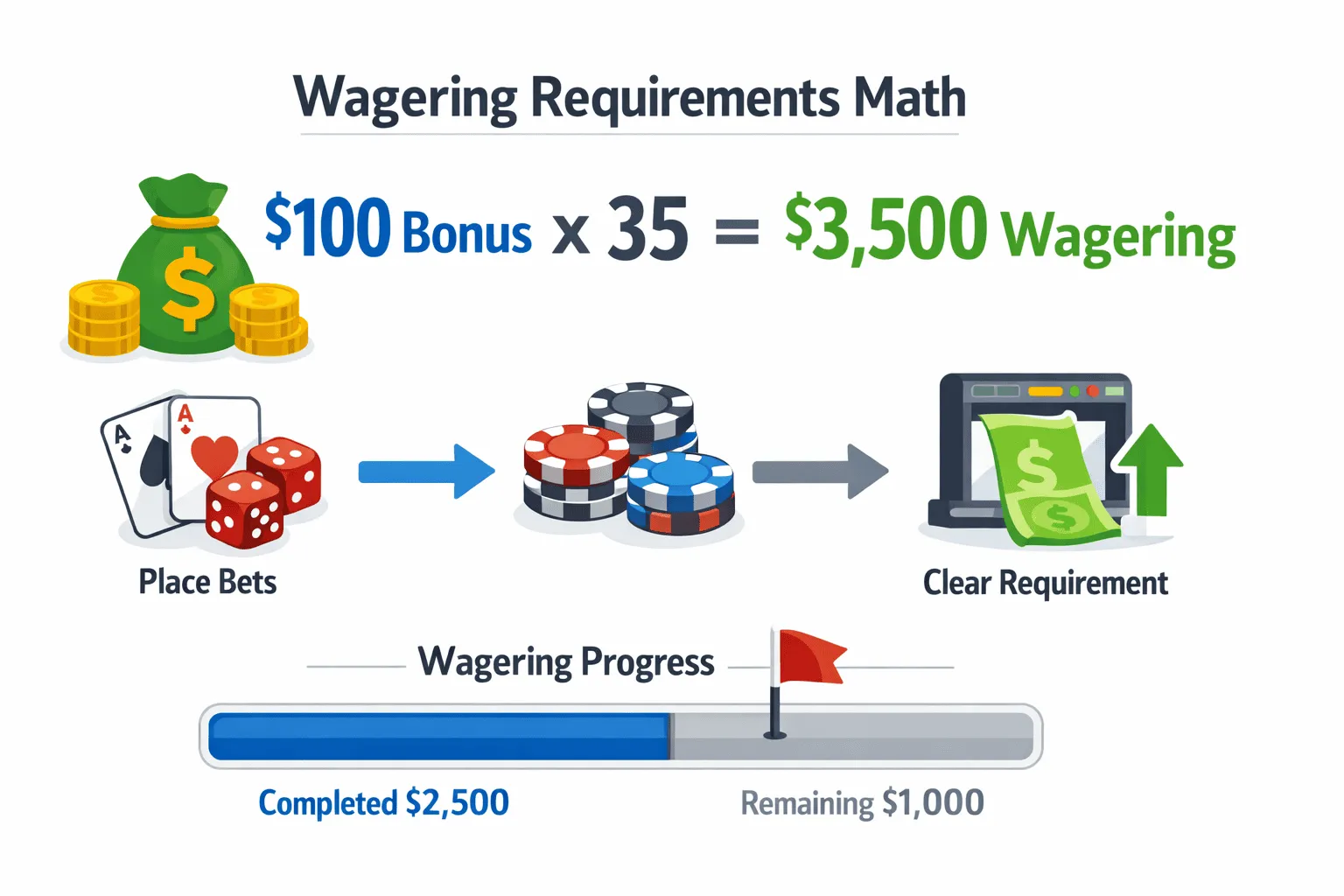
A wagering requirement is a multiplier that dictates how many times you must play through a bonus before it becomes real money. For example, if you receive a $100 bonus with a 35x wagering requirement, you must place $3,500 worth of bets ($100 x 35). It doesn’t matter if you win or lose those bets; it only matters that the money is staked. Read a plain-English overview of how wagering requirements work. If you’re specifically hunting for easier offers, you may also like our step-by-step guide on how to clear low wagering requirement casino bonuses.
The Role of Volatility (Variance)
Volatility refers to the risk level of a game.
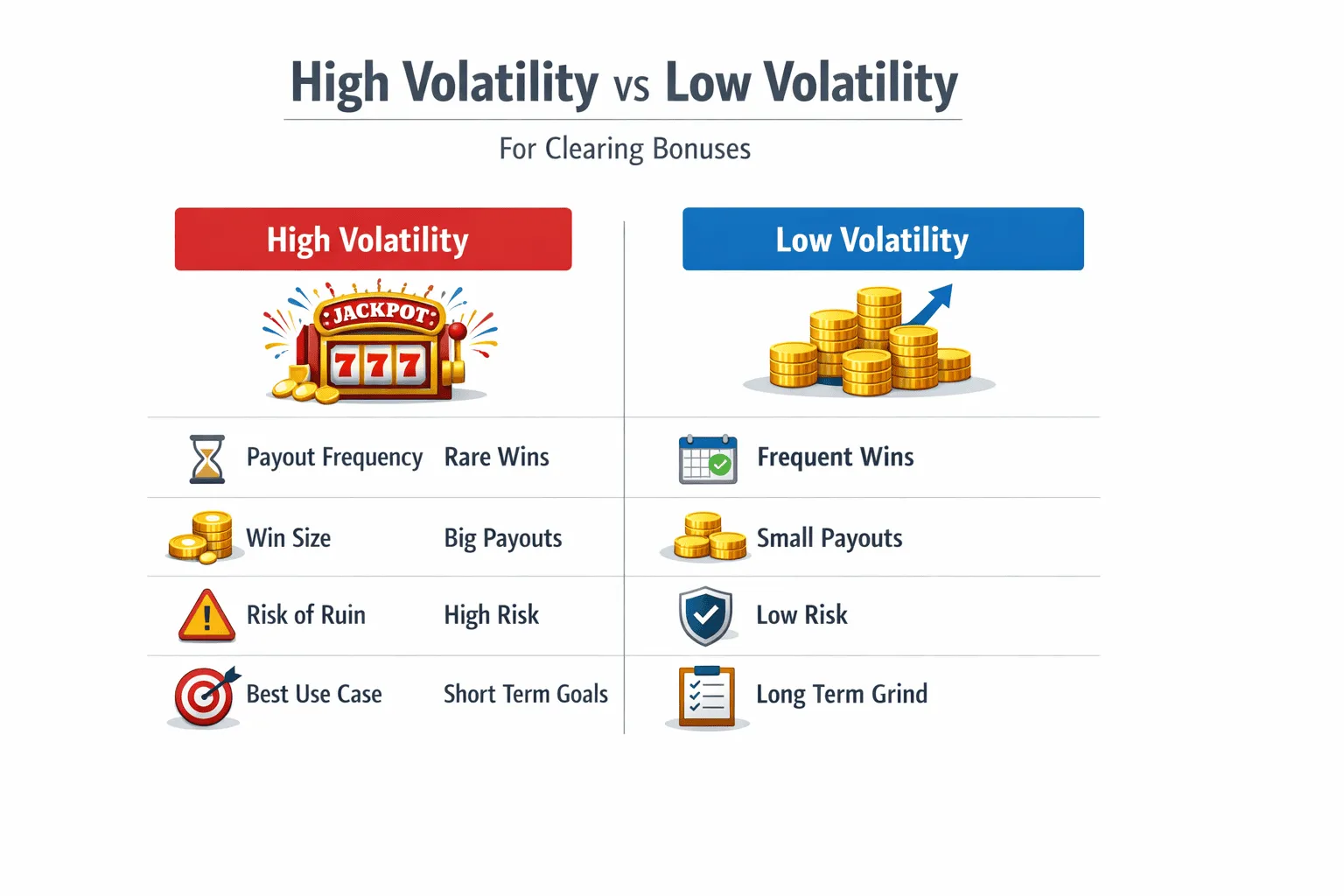
- High Volatility: Pays out less frequently but offers massive wins (e.g., jackpot slots).
- Low Volatility: Pays out frequently but the wins are smaller (often just keeping you afloat).
When clearing a bonus, your enemy is variance. High variance increases the “Risk of Ruin”—the probability that you will lose your entire balance before you finish the $3,500 wagering target. Low variance stabilizes your bankroll, allowing you to recycle your money over and over again to meet the requirement. If you want a deeper, more mathematical definition, see risk of ruin. For more practical examples tied to casino games, read our volatility/variance breakdown.
The Strategy: “Survive and Turnover”
The goal of this strategy is not to win big; it is to not lose. You want to finish the wagering requirement with as much of your starting balance intact as possible. Here is how to execute the Low-Volatility Strategy effectively.
Step 1: Scrutinize the Terms and Conditions
This is the most critical step. Casinos know which games are best for clearing bonuses, and they often penalize them. You need to check three things in the fine print:
- Game Weighting: Slots usually count 100% toward wagering. However, table games like Blackjack often only count 10% or 0%. If you bet $10 on Blackjack, only $1 might count toward your goal. Avoid low-weighted games. (More context: slots vs. table games—risk, skill, and expectations.)
- Excluded Slots: Casinos maintain a list of “forbidden” slots for bonus play. These are almost always the highest RTP (Return to Player) and lowest volatility games (e.g., Blood Suckers or 1429 Uncharted Seas). Playing these can void your bonus.
- Max Bet Rule: Most bonuses have a maximum bet limit (commonly $5 or €5). Exceeding this even once can lead to the forfeiture of your winnings.
Step 2: Identify the Right Games
Once you know which games are allowed, you need to filter for specific metrics. You are looking for a “Goldilocks” zone of high RTP and low volatility.
| Feature | What to Look For | Why It Matters |
|---|---|---|
| RTP (Return to Player) | 96.5% or higher | Mathematically reduces the amount the casino “keeps” over the long run. (If RTP is new to you, read more about what RTP means and how it’s used, or see our plain-language explainer on casino odds, RTP & house edge.) |
| Volatility | Low or Low-Medium | Ensures a steady stream of small wins to maintain your balance. |
| Hit Frequency | 25% or higher | Frequent wins keep your morale up and your bankroll stable. |
Pro Tip: If you can’t find volatility data, play the game in “demo mode” for 50-100 spins. If you trigger small wins frequently but rarely see a big drop or a massive spike, it is likely low volatility.
Step 3: Bet Sizing
Consistency is key. Erratic betting spikes variance. Calculate a bet size that allows for at least 500 to 1,000 spins based on your current balance. (If you want a broader framework for managing bankroll and downside, read risk management in gambling.)
For example, if you have a $100 balance, betting $1 per spin gives you 100 spins guaranteed—but with low volatility, you will win back a portion of most bets, extending your playtime significantly. A $0.50 or $1.00 bet is usually sufficient to make progress without risking a rapid bust-out.
Step 4: Monitor Your Progress
Most modern casinos have a progress bar for wagering. Check this frequently. As you approach the finish line, play even more conservatively. If you have $200 left to wager and a $150 balance, there is zero need to take risks. Drop your bet size to the minimum to safely cross the finish line.
When to Switch Strategies
Is the Low-Volatility Strategy always the right choice? Not necessarily. It depends on your balance relative to the wagering requirement.
- Scenario A: Large Balance, High Wagering Remaining. Stick to Low Volatility. You have the funds to weather the grind.
- Scenario B: Tiny Balance, High Wagering Remaining. If you have $10 left and need to wager $1,000, low volatility will slowly bleed you to zero. In this specific case, you might switch to High Volatility briefly. You need a big win to boost your balance back to a sustainable level. If you hit that big win, immediately switch back to the Low-Volatility Strategy to protect it. (Related: why many “systems” don’t beat casino math long-term in why gambling systems fail over time.)
Responsible Gambling and Safety
While this guide focuses on strategy, it is vital to remember that the “House Edge” ensures the casino always wins in the long term. No strategy guarantees profit.
Never chase losses. If you bust out while trying to clear a bonus, accept the loss. Depositing real money to “chase” a bonus wagering requirement is a common trap that leads to problem gambling. Treat the bonus as entertainment; if you clear it, it’s a pleasant surprise, not a salary. If you want a clear checklist for staying in control, read our Responsible Gambling Guide: limits, risks & safety tips.
If gambling stops feeling fun or starts feeling hard to control, consider reaching out for confidential support via the National Council on Problem Gambling (U.S. resources, including the National Problem Gambling Helpline). You may also find it helpful to read when to walk away: knowing the difference between entertainment and risk.
Frequently Asked Questions
Can I play Blackjack or Roulette to clear wagering requirements?
Usually, no. Most casinos weight these games at 10% or less. This means if you need to wager $1,000, playing Blackjack would require you to actually place $10,000 in bets to clear it. It is rarely mathematically favorable compared to slots. (More detail here: slots vs. table games.)
What happens if I play a restricted game by accident?
If you play a game listed in the “excluded” section of the T&Cs, the casino reserves the right to confiscate your bonus and any winnings derived from it. Always check the list first.
Why do casinos exclude high RTP slots?
Casinos exclude slots with extremely high RTP (like 98%+) because they give the player a near-even playing field. When combined with a bonus, these games can swing the statistical edge in favor of the player, which the casino prevents to protect their profit margins.
Related guides
Knowledge Base-
Live Dealer vs. RNG Blackjack: Odds, Speed, and Strategy Compared
Compare Live Dealer vs. RNG Blackjack to find the best odds and speed. Discover how gameplay style, fairness, and strategy differ in this expert guide.
Knowledge Base
-
RTP vs. Volatility: How to Choose the Right Slot for Your Budget
Learn the difference between RTP and volatility in slots. Discover how to choose the right game to maximize your playtime and match your budget.
Knowledge Base
-
Data-Driven Bankroll Management: Using the Kelly Criterion in Online Casinos
Master data-driven bankroll management with the Kelly Criterion. Learn how to optimize bet sizing, manage risk, and maximize growth in online casinos.
Knowledge Base