
Common Gambling Myths (and Why They’re Wrong): The Science Behind the House Edge
Discover the truth behind common gambling myths and the math that ensures the house always wins over time.

Human beings are wired to find patterns in chaos. It’s a survival mechanism that served us well when tracking seasons or avoiding predators. However, when you step onto a casino floor or log into a betting app, that same instinct becomes your worst enemy.

The gambling industry is built on a bedrock of mathematics that guarantees the house a profit over time. Yet, myths persist—tales of “hot” slot machines, “due” roulette numbers, and “fail-safe” betting systems. These aren’t just harmless superstitions; they are cognitive distortions that lead to chasing losses and irrational decision-making.
In this guide, we strip away the superstition and look at the cold, hard probability behind the most common gambling myths. Understanding why these beliefs are wrong isn’t just about being smart; it’s about being a responsible player. (If you’re looking for a broader overview of casino play and how online gambling works, start here: online casinos.)
Myth #1: “I’m Due for a Win” (The Gambler’s Fallacy)
Perhaps the most pervasive and damaging myth is the belief that past results influence future outcomes in games of pure chance. This is known formally as the Gambler’s Fallacy. (Read the full breakdown and examples here: What is the Gambler’s Fallacy?.)
The Myth
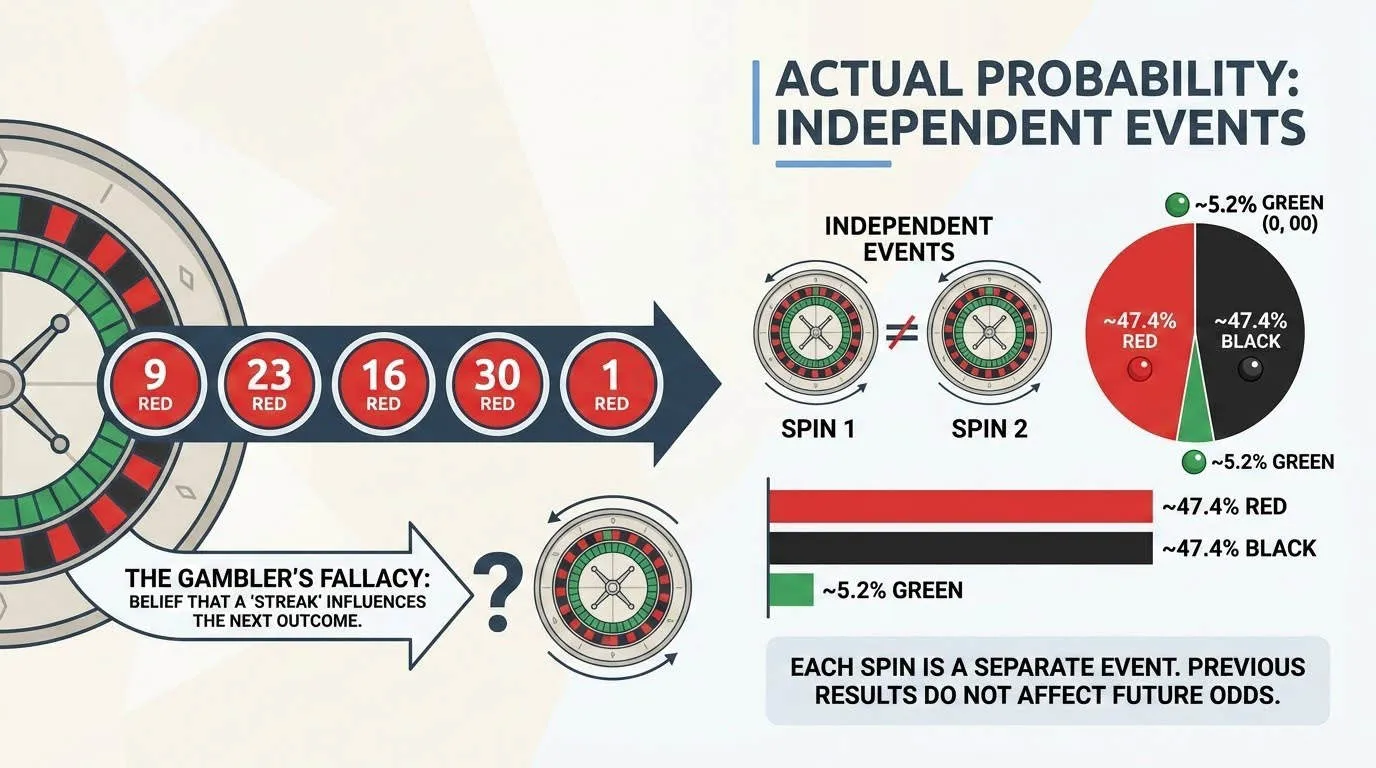
You’re at a roulette table. The ball has landed on “Red” five times in a row. You instinctively bet heavily on “Black,” convinced that Red cannot possibly hit six times straight. Black is “due” to appear to balance the universe.
The Reality
The roulette wheel has no memory. It does not know that it just landed on Red five times, nor does it care. Every single spin is an independent event.
In a standard game of American Roulette, there are 18 red pockets, 18 black pockets, and 2 green pockets (0 and 00). The probability of hitting Red is approximately 47.4% on every single spin, regardless of what happened ten seconds ago or ten days ago. While the odds of a coin flipping heads 10 times in a row are low (roughly 1 in 1,024), once the first 9 heads have landed, the odds of the 10th flip being heads remain exactly 50/50.
This misconception is also often called the “law of averages” or the “maturity of chances.” If you want a clearer definition, see: Fallacy of the Maturity of Chances.
Myth #2: “That Machine is Hot” (The Hot Hand Fallacy)
While the Gambler’s Fallacy expects a reversal of a trend, the “Hot Hand” fallacy expects the trend to continue indefinitely.
The Myth
You see a shooter at the craps table rolling winning numbers repeatedly, or a slot machine paying out back-to-back small wins. You assume the person or machine is “hot” and will continue to payout.
The Reality
In games of chance like slots, craps, or roulette, “streaks” are simply a manifestation of variance. In a random dataset, clusters of wins and losses are statistically inevitable. If you flip a coin 1,000 times, you will almost certainly see streaks of 6, 7, or 8 heads in a row. These clusters look meaningful to the human brain, but they are just random noise.
Modern slot machines use a Random Number Generator (RNG). The RNG cycles through millions of number combinations per second. The result of your spin is determined the nanosecond you press the button. The machine does not have a “temperature,” and it does not operate in cycles of “hot” or “cold.” (For practical tips that focus on what you can control—like bankroll, volatility, and expectations—see: slots strategy and tips.)
Myth #3: Betting Systems Can Beat the House
For centuries, mathematicians and gamblers have tried to devise systems to overcome the house edge. The most famous of these is the Martingale System. (If you want a dedicated explainer with examples, read: What is the Martingale System?.)
The Myth
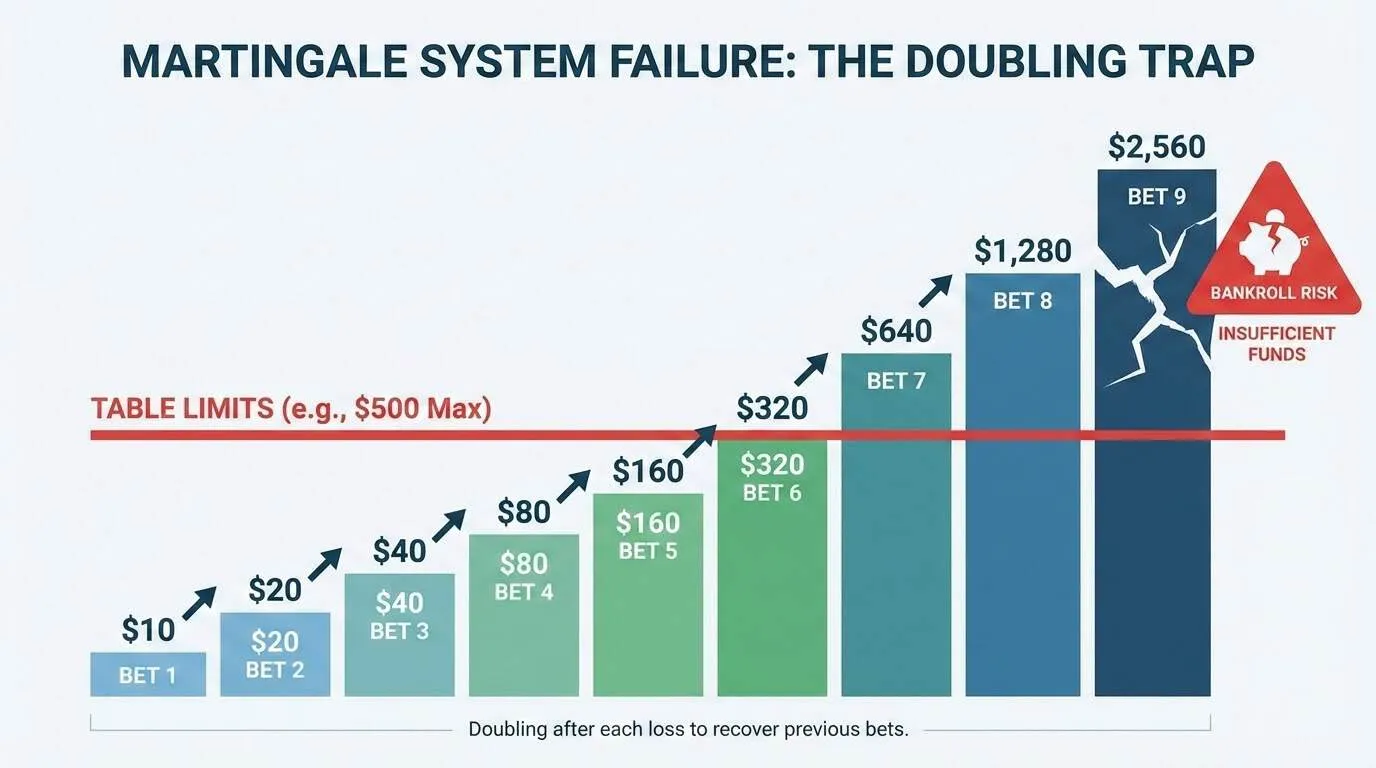
The Martingale strategy suggests that after every loss, you should double your bet. The logic is that eventually, you must win, and that win will cover all previous losses plus provide a small profit equal to your original stake.
The Reality
The Martingale fails for two main reasons:
- Exponential Growth: Doubling your bet grows expensive remarkably fast. If you start with a $10 bet and lose 8 times in a row, your 9th bet would need to be $2,560 just to win your initial $10 back.
- Table Limits: Casinos are aware of this system. That is why every table has a maximum bet limit. Eventually, a losing streak will force you to bet an amount higher than the table allows, or higher than your bankroll can support, leading to catastrophic loss.
No betting system can change the mathematical house edge of the game. They only change the volatility of your wins and losses. (If you’re curious about alternative progressions people use, compare it with: the Contra d’Alembert betting system.)
Myth #4: Casinos Pump Oxygen to Keep You Awake
This is a classic urban legend often repeated in movies and pop culture.
The Reality
Casinos do not pump extra oxygen onto the gaming floor. Not only would this be a massive fire hazard, but it is also illegal and expensive. Casinos keep you playing through other environmental psychology tactics:
- Lack of Clocks and Windows: Removing time cues disrupts your circadian rhythm and sense of time passing.
- Near-Miss Programming: Slot machines are designed to show “near misses” (e.g., two jackpots and a blank on the payline) more frequently than chance would dictate, stimulating the “I almost won” feeling. Read more about how near-miss outcomes can influence betting behavior in this open-access research article from Cambridge University Press: The impact of near-miss events on betting behavior.
- Free Alcohol: Alcohol lowers inhibitions and impairs judgment, making risky bets seem more attractive.
Myth #5: “If I Play Perfectly, I Will Win”
This myth is common among Blackjack and Poker players.
The Reality
While games like Blackjack and Poker do involve an element of skill, they are still bound by probability. In Blackjack, playing “Basic Strategy” perfectly reduces the house edge to roughly 0.5%, but it does not eliminate it. This means that for every $100 you bet, you are still statistically destined to lose $0.50 over the long run.
In Poker, you are playing against other players, not the house (though the house takes a “rake”). While a skilled player can consistently beat unskilled players, “bad beats” (losing a hand where you were the statistical favorite) are an unavoidable part of the game.
The Takeaway: Treat Gambling as Entertainment, Not Income
The most dangerous myth of all is the belief that gambling is a viable way to make money. The math is always skewed in favor of the operator. This is known as Negative Expected Value (-EV).
Understanding these myths protects you. When you realize that the roulette wheel has no memory and the slot machine isn’t “due,” you can let go of the compulsion to chase losses. Enjoy the thrill of the uncertainty, but never bet money you cannot afford to lose. (For a practical framework on setting limits and protecting your bankroll, read: risk management in gambling.)
Responsible Gambling Resources
If you or someone you know is struggling with gambling addiction, help is available. Belief in these myths can be a sign of problem gambling.
- National Problem Gambling Helpline (USA): 1-800-522-4700 (learn more about the National Problem Gambling Helpline’s 24/7 call/text/chat options here: National Council on Problem Gambling).
- GamCare (UK): 0808 8020 133
- Gamblers Anonymous: www.gamblersanonymous.org
- Optional: Chat Support (USA): If calling feels like too much, you can also use the official National Problem Gambling Helpline chat.
Related guides
Knowledge Base-
Live Dealer vs. RNG Blackjack: Odds, Speed, and Strategy Compared
Compare Live Dealer vs. RNG Blackjack to find the best odds and speed. Discover how gameplay style, fairness, and strategy differ in this expert guide.
Knowledge Base
-
RTP vs. Volatility: How to Choose the Right Slot for Your Budget
Learn the difference between RTP and volatility in slots. Discover how to choose the right game to maximize your playtime and match your budget.
Knowledge Base
-
Data-Driven Bankroll Management: Using the Kelly Criterion in Online Casinos
Master data-driven bankroll management with the Kelly Criterion. Learn how to optimize bet sizing, manage risk, and maximize growth in online casinos.
Knowledge Base