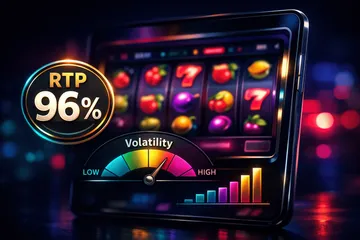
Game Volatility & Variance Explained: Why Player Experiences Differ
Explore game volatility and variance to understand differing player experiences in online slots. Discover why outcomes can differ.

Imagine two friends, Sarah and Mike. They both sit down to play the exact same online slot game with the same budget. An hour later, Sarah has doubled her money after hitting a massive jackpot, while Mike has slowly whittled his balance down to zero without a single significant win. They played the same game, with the same rules and the same return-to-player (RTP) percentage. How is this possible?

The answer lies in two often-misunderstood concepts: volatility and variance. While the “house edge” determines the casino’s long-term profit, volatility determines the feel of the gameplay and the short-term swings in your bankroll. Understanding these mechanics is crucial for any player who wants to manage their expectations and choose games that align with their playing style. If you also want a practical framework for protecting your bankroll, read our guide on risk management in gambling.
What is Game Volatility?
In the world of gaming—specifically slots and casino games—volatility refers to the level of risk associated with a specific game. It describes the frequency and size of payouts you can expect during a session.
Think of it as the “personality” of the game. Does it pay out small amounts frequently to keep you afloat? Or does it stay quiet for long periods, only to explode with a massive win? This behavior is dictated by the game’s volatility setting.
Volatility vs. Variance: Is There a Difference?
You will often hear the terms “volatility” and “variance” used interchangeably in casino guides and game reviews. For the purpose of a player, they mean the same thing.
- Variance is the statistical term used by mathematicians and game designers to describe the deviation from the average return.
- Volatility is the term more commonly used in the casino industry and by players to describe the risk factor.
Regardless of which word you use, you are talking about the distribution of wins. It’s also helpful to remember that randomness can trick your brain into seeing patterns – something explained well in guides to the gambler’s fallacy (and related misconceptions).
The Three Main Levels of Volatility
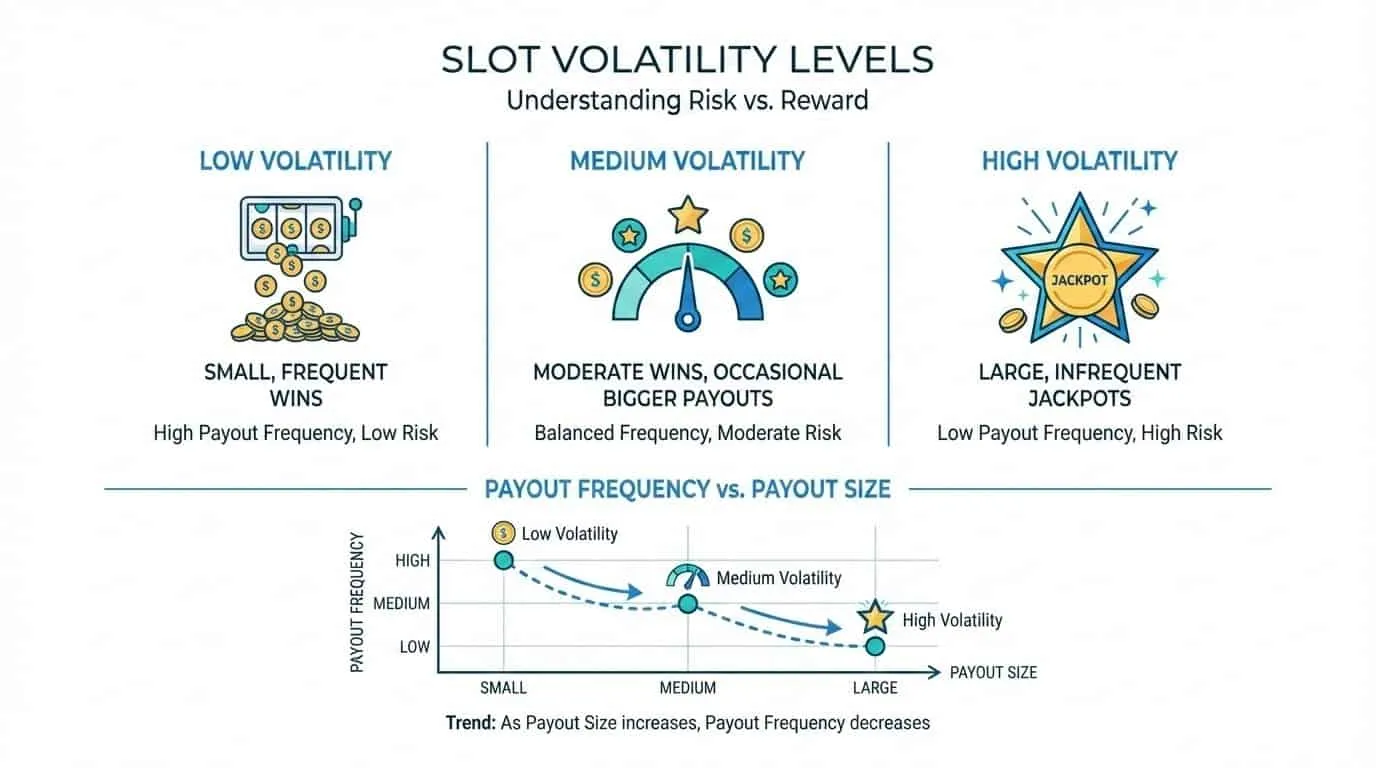
To understand why experiences differ so wildly, we must look at the different categories of volatility. Most game developers classify their titles into three main buckets: Low, Medium, and High.
1. Low Volatility: The “Slow and Steady”
Low volatility games are designed for extended playtime. They offer frequent, smaller wins. It is rare to lose your entire bankroll quickly on a low volatility game, but it is equally rare to win a life-changing sum in a single spin.
- Player Experience: You feel like you are winning often. The game provides constant positive feedback with bells and whistles, even if the win is just equal to your bet size.
- Best For: Casual players, those with smaller bankrolls, or players looking to clear wagering bonuses. For a step-by-step approach, see how to clear low wagering requirement casino bonuses.
2. High Volatility: The “Feast or Famine”
High volatility games are high-risk, high-reward. These games can go through long “dry spells” where you win absolutely nothing for many spins. However, when they do pay out, the wins are often massive (1,000x, 5,000x, or even 50,000x your stake).
- Player Experience: It can feel frustrating and brutal. You might burn through $100 in minutes. But the thrill comes from the potential of that one massive hit that recoups all losses and then some.
- Best For: Thrill-seekers, high rollers, and players with a large bankroll who can withstand losing streaks. If you’re considering “systems” to manage those swings, it helps to understand what strategies can (and can’t) do—start with the classic Martingale system.
3. Medium Volatility: The Middle Ground
As the name suggests, these games try to bridge the gap. They offer a mix of frequent small wins and the occasional larger payout. They are the most popular category because they offer a balanced experience.
The Math Behind the Experience: RNG and RTP
To fully grasp why Sarah won and Mike lost, we need to look at two other acronyms: RNG (Random Number Generator) and RTP (Return to Player).

Every legitimate digital casino game uses an RNG. This ensures that every single spin, hand, or round is an independent event. The game has no memory; it doesn’t know that Mike has lost 20 times in a row, nor does it care that Sarah just won. For a regulator-focused explanation of how games can still meet a stated return percentage while remaining random, see the UK Gambling Commission’s guide: How can gaming machines meet their %RTP if they are random?.
RTP is a theoretical percentage of all wagered money that a game will pay back to players over time. For example, a slot with 96% RTP is programmed to return $96 for every $100 wagered.
Here is the catch: RTP is calculated over millions or even billions of spins. It is a long-term average, not a session guarantee. If you want more practical slot-focused advice that complements RTP/volatility basics, see our slots strategy and tips guide.
The “Why”: Short-Term Variance vs. Long-Term Average
This brings us back to our two players. Why were their experiences so different on the same game?
The answer is Short-Term Variance.
Because the RTP is a long-term average (millions of spins), a single session of a few hundred spins is statistically insignificant. In the short term, anything can happen. The volatility of the game dictates how wide that “anything” can be.
- In a Low Volatility game, the short-term results usually hug closer to the RTP. If Sarah and Mike played a low volatility game, their results would likely be more similar—both might end up slightly up or slightly down.
- In a High Volatility game, the standard deviation is massive. The graph of results looks like a jagged mountain range. Sarah happened to play during a “peak” (a variance upswing), hitting a bonus round that pays out the bulk of the game’s RTP. Mike played during a “valley” (a variance downswing), effectively paying for Sarah’s win.
The game is designed this way. For one player to win 5,000x their bet, hundreds of other players (or the same player over hundreds of spins) must lose. High volatility games rely on this disparity to fund their massive jackpots.
How to Choose Based on Volatility
Understanding volatility is the best tool you have for bankroll management. You shouldn’t just choose a game based on the theme or graphics; you should choose it based on your risk tolerance. If you want additional approaches (beyond volatility selection) for making smarter decisions, see these proven gambling strategies.
| Your Goal | Your Bankroll | Recommended Volatility |
|---|---|---|
| Entertainment, long sessions | Small / Limited | Low |
| Balance of fun and winning potential | Medium | Medium |
| Chasing huge jackpots | Large / High Disposable | High |
How to Check a Game’s Volatility
Developers are becoming more transparent about these stats. You can usually find the volatility rating in:
- The Game’s Info Screen: Look for the “i” or “?” button inside the game. Many developers now use a lightning bolt scale (e.g., 5/5 lightning bolts = High Volatility).
- Casino Reviews: Search for the game title online followed by “review” or “RTP”.
- The Paytable: If you can’t find the stat, look at the payouts. If the difference between the lowest symbol payout and the highest symbol payout is massive (e.g., 5x vs 10,000x), it is likely high volatility. If the payouts are flatter (e.g., 10x vs 200x), it is likely low volatility.
It also helps to understand why random rewards can feel so compelling. Gambling is often discussed in psychology through the lens of a variable ratio schedule of reinforcement, which tends to make behaviors highly persistent even when rewards are unpredictable. A detailed overview (including how “near misses” can reinforce continued play) is covered in the NCBI Bookshelf’s educational chapter on gambling concepts: Gambling Concepts and Nomenclature (NCBI Bookshelf).
If you’re using volatility knowledge for safer play, it’s worth pairing it with concrete limit-setting (time and money) and other harm-reduction strategies. The National Council on Problem Gambling (NCPG) provides practical responsible gambling resources here: Responsible Gambling (NCPG).
Conclusion
The next time you see a streamer land a massive win, or you find yourself on a losing streak, remember the concept of volatility. It explains why two players on the same game can live in two different realities.
High volatility brings the adrenaline of the chase but carries the risk of a quick exit. Low volatility ensures a longer session but limits the ceiling of your wins. By matching the game’s variance to your bankroll and temperament, you can ensure that your gaming experience remains fun, regardless of whether the RNG is in your favor today. For a deeper dive into “being due” and similar misconceptions that volatility often amplifies, you can also read about the fallacy of the maturity of chances.
For readers who want a deeper look at the psychology behind gambling-related thinking patterns (like illusion of control and other cognitive distortions), PubMed has a classic research abstract here: Cognitive distortions in heavy gambling (PubMed).
Related guides
Knowledge Base-
Live Dealer vs. RNG Blackjack: Odds, Speed, and Strategy Compared
Compare Live Dealer vs. RNG Blackjack to find the best odds and speed. Discover how gameplay style, fairness, and strategy differ in this expert guide.
Knowledge Base
-
RTP vs. Volatility: How to Choose the Right Slot for Your Budget
Learn the difference between RTP and volatility in slots. Discover how to choose the right game to maximize your playtime and match your budget.
Knowledge Base
-
Data-Driven Bankroll Management: Using the Kelly Criterion in Online Casinos
Master data-driven bankroll management with the Kelly Criterion. Learn how to optimize bet sizing, manage risk, and maximize growth in online casinos.
Knowledge Base