Hidden Signals of Gambling Addiction: What Friends and Family Often Miss
Discover the subtle, often missed signs of gambling addiction. Learn how to spot the hidden red flags in friends or family and how to offer support.

Gambling addiction is frequently called the “hidden addiction.” Unlike alcohol or drug dependency, there are often no physical signs—no slurred speech, no stumbling, and no scent of smoke or chemicals. For friends and family, this invisibility can be terrifying. You may sense something is wrong, but you can’t quite put your finger on it. The person you love might seem present, yet distant; anxious, yet evasive.

If you are reading this, you likely have a gut feeling that something isn’t right. Trust that instinct. Problem gambling thrives in secrecy, and the signs are often subtle until the situation becomes critical. This guide is designed to help you identify those hidden signals—the behavioral, emotional, and financial nuances that are easily overlooked—so you can approach your loved one with compassion and clarity.
The Psychology of Secrecy
To understand the signs, it helps to understand the mindset of a compulsive gambler. Shame is a powerful driver. Most individuals suffering from gambling disorder do not want to hurt their families; they are often convinced that the “next big win” will fix everything. This belief system creates a complex web of lies and defensiveness designed to protect their secret and, in their minds, protect you from the truth until they can “fix it.”
For a deeper look at why gambling feels so compelling (and why it can become hard to stop), you may also want to read: The Psychology of Gambling: Why Casinos Feel So Engaging.
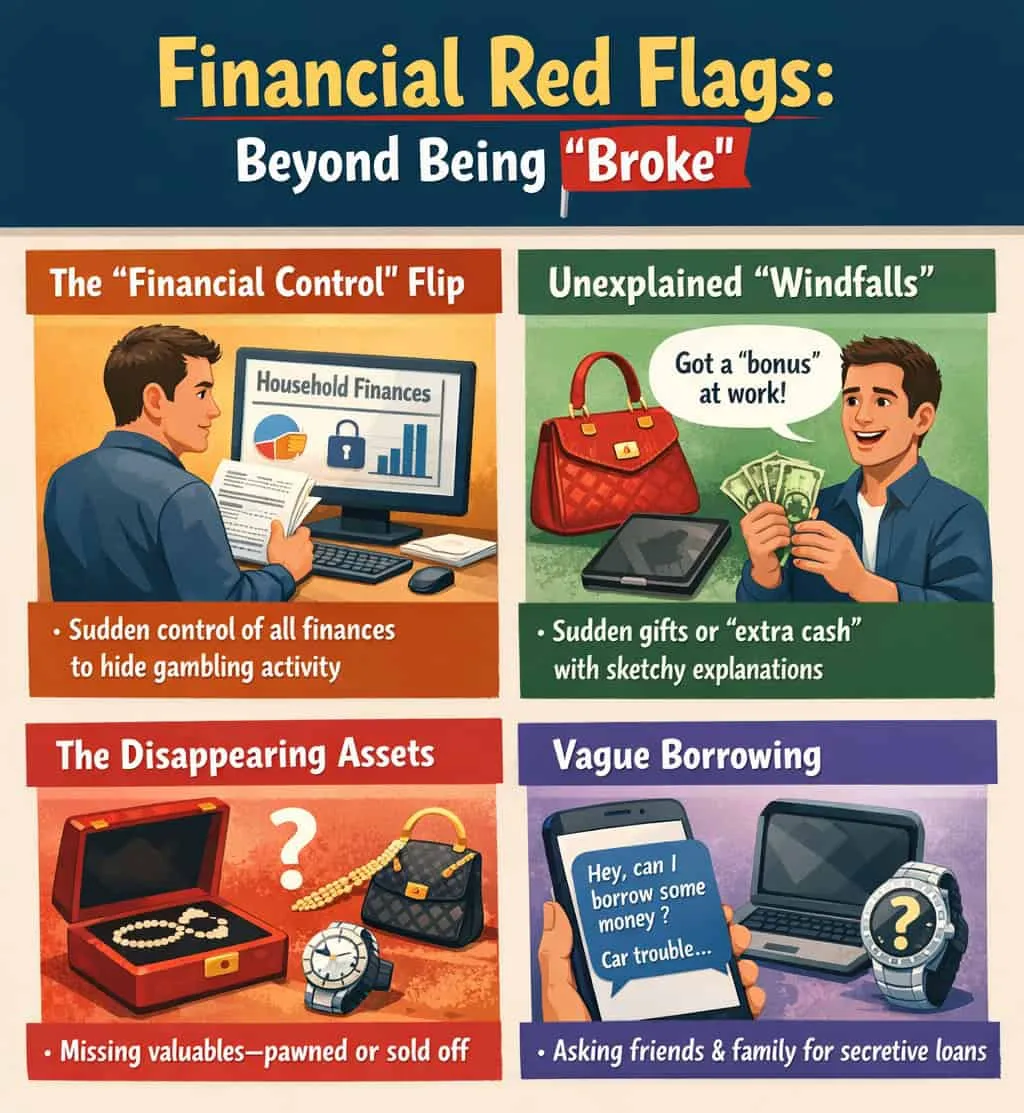
1. Financial Red Flags: Beyond Being “Broke”
While a lack of money is an obvious sign, the hidden signals are often found in how money is managed and discussed.
- The “Financial Control” Flip: Paradoxically, a partner hiding a gambling habit may suddenly insist on controlling all the household finances. This allows them to intercept bank statements, credit card offers, and late notices before you see them.
- Unexplained “Windfalls”: They might come home with expensive gifts or sudden cash, attributing it to a bonus at work or a repayment of a loan you didn’t know they made. These highs often correspond to winning streaks and are used to alleviate guilt.
- The Disappearing Assets: It’s not just cash. Look for missing valuables—electronics, jewelry, or collectibles. They might claim these items were lost or lent to a friend, when in reality they have been pawned or sold.
- Vague Borrowing: They may ask friends or extended family for small loans with vague excuses (“My car broke down,” “I lost my wallet”), avoiding asking you directly to keep you in the dark.
If you want practical ways to reduce harm quickly (especially around money boundaries), see our Responsible Gambling Guide: Limits, Risks & Safety Tips.
Read more about common financial and behavioral warning signs from a public health perspective here: signs your loved one may have a problem.
2. The “Digital Drift”: Technology and Isolation
In the age of online betting and casino apps, a casino is carried in the pocket 24/7. This accessibility creates specific behavioral patterns.
To better understand how modern online gambling is built to keep people playing (and why it’s so easy to hide), read: How Online Casinos Really Work: RNGs, Algorithms, and the House Edge.

Protective Phone Habits
Does your loved one suddenly have a passcode on their phone when they didn’t before? Do they turn the screen away when you walk into the room? Flipping the phone face-down immediately upon receiving a notification is a common reflex for those hiding betting apps or messages from creditors.
The “Zone”
Gamblers often enter a trance-like state while playing, known as “the zone.” If you notice your friend or partner is physically present but mentally absent—staring at a screen, unresponsive to conversation, or agitated when interrupted—they may be deep in a gambling session, even while sitting on the living room couch.
3. Emotional and Physical Shifts
Because there is no chemical substance involved, family members often attribute mood swings to stress at work or relationship issues. However, the dopamine cycle of gambling creates severe emotional volatility.
- The Unexplained Anxiety: Watch for restlessness, sweating, or tremors that don’t seem to have a cause. This is often withdrawal or the immense stress of chasing losses.
- Defensiveness: A simple question like “How was your day?” or “What did you do this afternoon?” might be met with hostility or an accusation that you are “checking up on them.” This defensive projection is a classic mechanism to deflect scrutiny.
- Sleep Disturbances: Insomnia is rampant among problem gamblers. The stress of debt and the adrenaline of late-night online sessions can wreak havoc on sleep patterns.
- Loss of Interest: Hobbies, sports, or social activities they once loved may now seem boring compared to the thrill of the gamble. If a sports fan suddenly stops watching games—or conversely, becomes obsessively anxious about the outcome of a game involving a team they don’t care about—it is a significant warning sign.
Many people find it helpful to compare their situation against a clear line between “still entertainment” and “becoming risk.” Read: When to Walk Away: Knowing the Difference Between Entertainment and Risk.
4. Time Distortion
Gamblers often lose track of time. You might notice:
- Unexplained absences from home or work.
- Taking unusually long to run simple errands (e.g., a 20-minute trip to the store takes two hours).
- “Sick days” from work that aren’t discussed, or a drop in productivity and unexplained lateness.
How to Approach the Situation
If you recognize these hidden signals, your immediate reaction might be anger or panic. This is natural, but confrontation born of anger often leads to further withdrawal. Because gambling addiction is a YMYL (Your Money, Your Life) health issue, it requires a careful, steady approach.
Choose the Right Moment
Do not start the conversation when you have just discovered a missing payment or when they are stressed. Choose a calm, private time.
Use “I” Statements
Avoid accusations like “You are gambling again.” Instead, say, “I’ve noticed you’ve been anxious lately and money seems tight. I’m worried about you and I want to help.”
Focus on the Behavior, Not the Person
Remind them (and yourself) that the addiction is the problem, not their character. They are likely drowning in shame; empathy can be the lifeline they need to admit the truth.
If they minimize the behavior with “systems” or “strategies,” it can help to understand why those don’t reliably change outcomes. Read more here: Why Gambling Systems Fail Over Time: The Mathematics of the House Edge.
Next Steps and Resources
You do not have to navigate this alone. Professional help is often necessary to break the cycle of addiction.
- National Problem Gambling Helpline (USA): 1-800-522-4700 (Confidential and available 24/7)
- Gam-Anon: Support groups specifically for the families and friends of compulsive gamblers.
- Therapy: Cognitive Behavioral Therapy (CBT) has shown great success in treating gambling disorders. For a deeper dive into the research evidence, see this systematic review and meta-analysis: Effect of cognitive-behavioral techniques for problem gambling and gambling disorder.
If you’re looking for an additional, easy-to-scan checklist of warning signs (including family impacts like missing valuables and reduced communication), see: Know the Signs (Nevada Council on Problem Gambling).
If you have questions about safe play tools, player protections, or how online gambling is regulated in different places, you may also find this helpful: Gambling Laws & Regulations: What Players Should Know.
Disclaimer: This article is for informational purposes only and does not constitute medical advice. If you suspect a loved one is in immediate danger or severe distress, please contact emergency services or a mental health professional immediately.
Related guides
Knowledge Base-
Live Dealer vs. RNG Blackjack: Odds, Speed, and Strategy Compared
Compare Live Dealer vs. RNG Blackjack to find the best odds and speed. Discover how gameplay style, fairness, and strategy differ in this expert guide.
Knowledge Base
-
RTP vs. Volatility: How to Choose the Right Slot for Your Budget
Learn the difference between RTP and volatility in slots. Discover how to choose the right game to maximize your playtime and match your budget.
Knowledge Base
-
Data-Driven Bankroll Management: Using the Kelly Criterion in Online Casinos
Master data-driven bankroll management with the Kelly Criterion. Learn how to optimize bet sizing, manage risk, and maximize growth in online casinos.
Knowledge Base