How Online Casinos Really Work: RNGs, Algorithms, and the House Edge
Discover how online casinos really work, exploring RNGs, algorithms, and the house edge for a better gaming experience.

Every time you press “spin” on a digital slot or place a chip on a virtual blackjack table, a complex series of events occurs in a fraction of a second. For many players, the mechanics behind online casinos are a “black box”, a mystery fueled by superstitions about “hot” streaks and “rigged” software.

But the reality of online gambling isn’t magic; it is mathematics, cryptography, and rigorous regulation. Understanding how online casinos really work is the best defense against fraud and the most effective way to manage your bankroll responsible.
This guide pulls back the curtain on the technology that powers the industry, explaining Random Number Generators (RNGs), the role of licensing bodies, and the difference between true randomness and the mathematical certainty of the house edge.
The Heart of the System: Random Number Generators (RNGs)
At the core of every reputable online casino game, whether it’s a slot machine, video poker, or digital roulette, lies a piece of software called a Random Number Generator (RNG). This algorithm is the impartial referee determining the outcome of every round.
How RNGs Work
Contrary to popular belief, the RNG doesn’t start working the moment you click a button. It is perpetually active, generating thousands of number sequences every second, even when no one is playing.
When you hit “spin,” the software freezes the RNG at that precise millisecond and grabs the latest set of numbers. These numbers are then translated into the visual result you see on screen (e.g., three cherries or a Royal Flush).
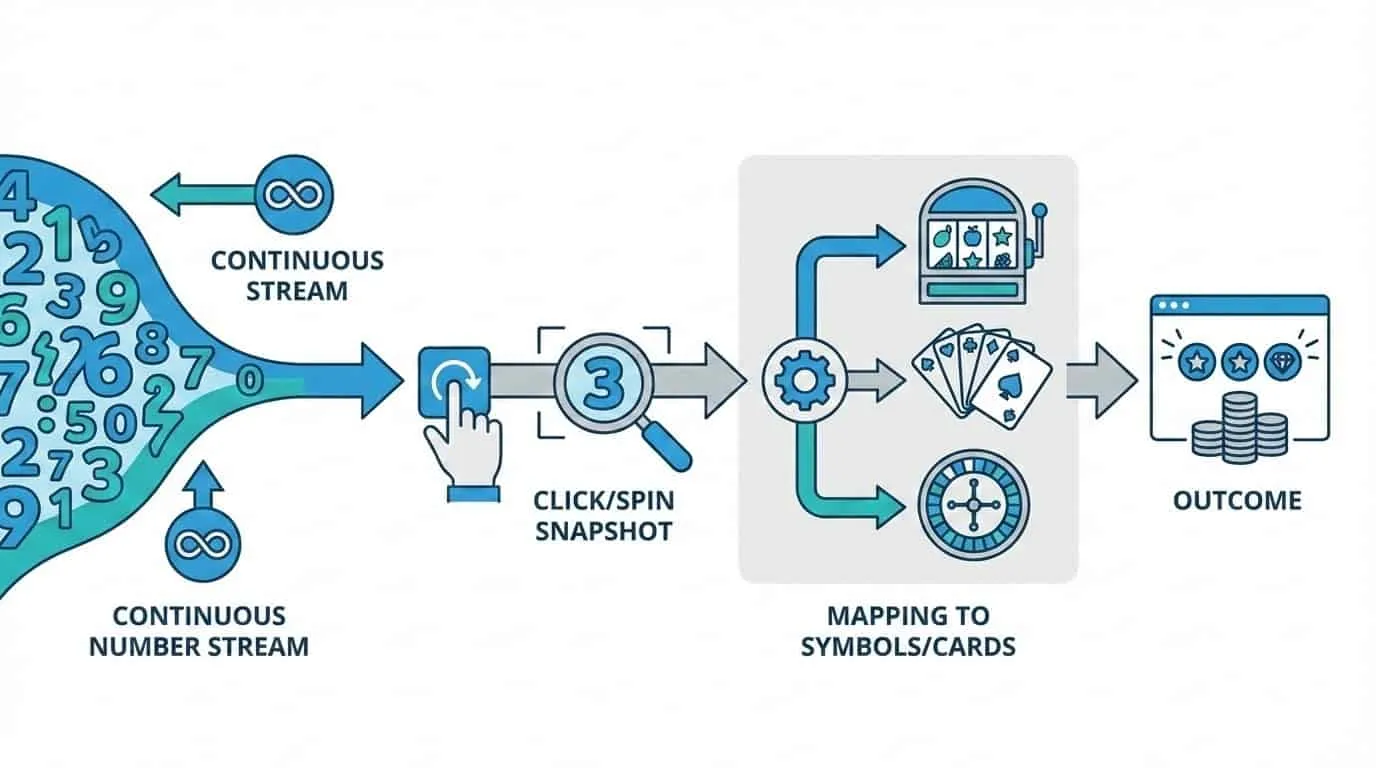
Most online casinos use Pseudo-Random Number Generators (PRNGs). While “pseudo” might sound less than ideal, these algorithms are sophisticated enough to be indistinguishable from true randomness for the purpose of gaming. They require a “seed value” (a starting point) to generate results. To ensure unpredictability, this seed is often derived from highly variable physical sources, such as:
- System clock timestamps (down to the microsecond)
- Mouse movements
- Keystroke intervals
For a deeper look at how independent labs evaluate RNG randomness, seeding, and non-repeatability, read more about RNG testing methodologies used by iTech Labs.
The Myth of “Hot” and “Cold” Cycles
Because the RNG has no memory, every spin is an independent event. The algorithm does not know that you lost the last ten hands, nor is it programmed to “pay out” because a jackpot hasn’t hit in a while. The odds of hitting a jackpot are exactly the same on your first spin as they are on your thousandth spin.
If you find yourself “seeing patterns” in randomness, it may help to understand common thinking traps that show up in gambling (like the gambler’s fallacy). Read more about getting support and understanding problematic gambling behavior via the NHS overview on gambling addiction.
Randomness vs. Fairness: Understanding RTP and House Edge
A common misconception is that if a game is “random,” you have a 50/50 chance of winning. This is incorrect. Randomness ensures that the outcome is unpredictable, but the payouts are mathematically structured to favor the casino over time.
Return to Player (RTP)
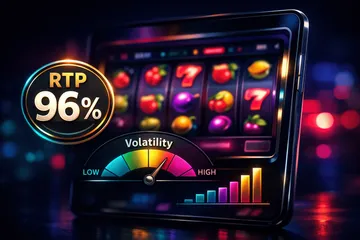
The RTP is a theoretical percentage that indicates how much of the wagered money a game pays back to players over an infinite number of spins. For example, a slot with a 96% RTP is designed to return $96 for every $100 wagered.
However, this is a long-term statistical average, not a guarantee for a single session. In the short term, variance (or volatility) reigns supreme. You could win $1,000 or lose $100 in ten minutes; the RTP only holds true over millions of rounds.
The House Edge
The “House Edge” is the flip side of RTP. If the RTP is 96%, the house edge is 4%. This is the mathematical advantage the casino holds. It ensures that the casino generates revenue to cover costs and make a profit, regardless of individual player wins. Reputable casinos do not need to rig the RNG because the math is already in their favor.
Who Watches the Watchmen? Licensing and Regulation
Software can be manipulated. If an operator controls the RNG, what stops them from lowering the RTP to 1%? This is where regulation and licensing come into play.
Legitimate online casinos must hold a license from a recognized jurisdiction. These regulatory bodies enforce strict standards regarding player safety, data protection, and game fairness.
Top-Tier Jurisdictions
- UK Gambling Commission (UKGC): Widely considered the strictest regulator. They require casinos to integrate with GamStop (a self-exclusion scheme) and enforce rigorous technical standards. You can review the UKGC’s Remote gambling and software technical standards (RTS) guidance to see the type of controls and testing expectations placed on licensees.
- Malta Gaming Authority (MGA): A gold standard for European and international casinos, focusing heavily on anti-money laundering (AML) and player protection. For an example of the player-safety requirements licensed operators are expected to meet, see the MGA’s player protection framework.
- Isle of Man & Gibraltar: both are highly respected jurisdictions with stringent vetting processes for operators.
Note: Licenses from jurisdictions like Curacao generally have lower barriers to entry and lighter oversight, though many legitimate crypto-casinos operate there.
The Audit: Proving the Numbers are Real
A license isn’t a one-time stamp of approval. To maintain it, casinos must submit their software and RNGs to independent third-party testing agencies. These auditors verify that the games perform as advertised.
Key Testing Agencies
- eCOGRA (eCommerce Online Gaming Regulation and Assurance): Based in London, this agency is the leading authority on fair gaming. If you see the eCOGRA seal in a casino’s footer, it means their RNGs have been certified fair and their payout percentages are accurate. Read more about eCOGRA’s RNG testing and certification process.
- iTech Labs: Specialists in testing online gaming systems, focusing on RNG certification and quality assurance.
- GLI (Gaming Laboratories International): A global leader providing testing and certification services to land-based and online lotteries and casinos.
What Do They Test?
- RNG Evaluation: They analyze the raw code and output data to ensure the numbers are statistically random and free from bias.
- Game Math Verification: They play millions of automated rounds to verify that the actual RTP matches the theoretical RTP claimed by the developer.
- Security Audits: Ensuring that player data and financial transactions are encrypted and secure from external hacks.
What Isn’t Random? (The Human Element)
While the RNG governs digital slots and blackjack, not everything in an online casino is purely algorithmic. There are exceptions where physics and skill enter the equation.
Live Dealer Games
Live casino games stream real human dealers from a studio. Here, there is no RNG determining if the card is a Queen or a King. Instead, the outcome depends on physical shuffles and the laws of physics (for roulette wheels).
However, technology still plays a role. Optical Character Recognition (OCR) technology scans the cards as they are dealt, converting physical data into digital information that allows the software to settle bets instantly.

Skill-Based Decisions
In games like Blackjack and Poker, the cards dealt are random (or RNG-determined), but the outcome is heavily influenced by player decisions. Using “Basic Strategy” in Blackjack can reduce the house edge to under 0.5%, whereas playing blindly can increase it significantly. Here, the “randomness” of the deal is only half the story; your skill determines the rest.
Conclusion: Trusting the Math
The question “Is this casino rigged?” is a natural one for any player losing money. However, in the regulated market, the answer is almost certainly “no.” The combination of complex RNGs, strict government licensing, and continuous third-party auditing creates a system where rigging is not only difficult but financially unnecessary for the operator.
The house wins not by cheating, but by relying on the Law of Large Numbers. By understanding the mechanics of RNGs and RTP, you can stop chasing patterns that don’t exist and treat online gambling for what it truly is: a form of paid entertainment governed by chance.
Safety Checklist: Before you play, scroll to the bottom of the casino’s homepage. Look for the license number (and verify it on the regulator’s site) and check for an audit seal from eCOGRA or iTech Labs. If these are missing, the RNG might not be the only thing that’s unpredictable.
Related guides
Knowledge Base-
Live Dealer vs. RNG Blackjack: Odds, Speed, and Strategy Compared
Compare Live Dealer vs. RNG Blackjack to find the best odds and speed. Discover how gameplay style, fairness, and strategy differ in this expert guide.
Knowledge Base
-
RTP vs. Volatility: How to Choose the Right Slot for Your Budget
Learn the difference between RTP and volatility in slots. Discover how to choose the right game to maximize your playtime and match your budget.
Knowledge Base
-
Data-Driven Bankroll Management: Using the Kelly Criterion in Online Casinos
Master data-driven bankroll management with the Kelly Criterion. Learn how to optimize bet sizing, manage risk, and maximize growth in online casinos.
Knowledge Base