How to Spot Unsafe or Shady Online Casinos: Red Flags & Scams
Learn to spot red flags and scams in online gambling to protect yourself from unsafe or shady online casinos.
The online gambling world is booming, but it is also a minefield for the unprepared. For every legitimate, regulated operator, there are dozens of “grey market” or outright fraudulent sites designed to separate you from your money without a fair fight.

Gambling falls under what Google classifies as YMYL (Your Money or Your Life) topics. This means the stakes are high—literally. Playing on a shady site doesn’t just mean losing a bet; it can mean identity theft, refused withdrawals, and compromised financial data. As an expert in iGaming safety, I have compiled this guide to help you identify the subtle and obvious warning signs of a rogue casino.
1. The Licensing Litmus Test
The single most critical factor in determining the safety of an online casino is its licensing. However, not all licenses are created equal, and some casinos simply fake them. If you want a safer starting point, begin with a curated list of online casinos and then verify each site’s license independently.
Tier 1 vs. Rubber-Stamp Regulators
Legitimate casinos operate under the strict supervision of government-backed bodies. These regulators enforce player protection, responsible gambling tools, and financial segregation (keeping player money separate from operational funds).
- High Trust (Tier 1): The UK Gambling Commission (UKGC), Malta Gaming Authority (MGA), and various US state regulators (like the NJ DGE) are the gold standard. They actively punish non-compliance.
- Moderate to Low Trust: Jurisdictions like Curacao or Anjouan offer licenses that are cheaper and easier to obtain. While many legitimate crypto casinos operate here, the oversight is significantly looser. A Curacao license alone is not a guarantee of safety.
How to Spot a Fake License
Scam sites often display a regulator’s logo in their footer to create a false sense of security. Do not trust the logo alone.
To verify a license:
- Scroll to the bottom of the casino’s homepage.
- Click the regulator’s logo. It should open a validation page hosted on the regulator’s official domain.
- If the logo is just a static image, or if the link redirects to a third-party site, it is likely a fake.
Read more: If you’re checking a UK-facing site, you can also verify operators directly via the UKGC’s official “Check a licensed gambling business” register. UK Gambling Commission (UKGC) — Check a licensed gambling business.
Read more: For Malta-licensed brands, the MGA provides a Licensee Register you can search by name/status/URL. Malta Gaming Authority (MGA) — Licensee Register.
2. Predatory Terms and Conditions
Rogue casinos often hide their scams in plain sight—inside the Terms and Conditions (T&Cs). They know most players won’t read the fine print. Here are the specific clauses that signal danger:
The “Vague Forfeiture” Clause
Look for terms that allow the casino to confiscate winnings for vague reasons. Phrases like “irregular play” or “bonus abuse” without clear definitions are often used to void jackpots.
Impossible Wagering Requirements
Bonuses are a standard marketing tool, but scam sites weaponize them. If you see a welcome bonus with a 60x or 70x wagering requirement applied to both the deposit and the bonus, it is mathematically impossible to clear. This locks your real money deposit until you lose it all. If you want to avoid getting trapped by playthrough tricks, see this guide on how to clear low wagering requirement casino bonuses.
Low Withdrawal Limits
Imagine winning $10,000, only to find the casino has a withdrawal limit of $500 per month. It would take you nearly two years to get your money out. Unsafe casinos use this tactic to frustration-bait players into gambling their balance away. A good way to protect yourself is to set clear limits and follow solid risk management in gambling principles before you deposit.
3. Technical Security and Website Quality
You wouldn’t hand your credit card to a store with a broken lock on the door. The same logic applies online.

Missing or Weak SSL Encryption
Check the browser address bar. If there is no padlock icon, or if your browser warns the connection is “Not Secure,” leave immediately. Legitimate casinos use 128-bit or 256-bit SSL encryption to protect data transfers.
Broken Links and unfinished Pages
Scam sites are often set up quickly (churn and burn). If you find “Lorem Ipsum” filler text, broken links in the “About Us” section, or a “Contact” page that only leads to a generic email form with no physical address, these are major red flags. If you ever need to reach us about a questionable operator you’ve found, you can use our contact page.
4. The Truth About Game Fairness (RNG)
How do you know the slot machine isn’t rigged to never pay out? Legitimate casinos do not control the payout percentages (RTP) of the games directly; they host games from licensed developers. For more practical advice, you can also read these slots strategy and tips (including what to look for in legit games and RTP).
Software Piracy
Shady casinos sometimes use “pirated” versions of popular games (like those from NetEnt or Pragmatic Play). These fake games look identical to the originals but are hosted on the casino’s own server with a manipulated Return to Player (RTP) rate.
How to check: Right-click on a game window and “Inspect Element” (or check the network traffic). If the game is loading from a domain that isn’t the official game provider’s server (e.g., casinoname-games.com instead of evolutiongaming.com), it is a pirated game.
Missing Audits
Look for seals of approval from independent testing agencies like eCOGRA, iTech Labs, or GLI. These companies audit the Random Number Generator (RNG) to ensure the game results are truly random.
Read more: If you want to understand what legitimate RNG testing looks like in practice, GLI publishes technical specifications outlining what manufacturers must submit for RNG testing. Gaming Laboratories International (GLI) — Technical specifications for RNG testing.
5. Review Manipulation and Bot Networks
In the digital age, reputation is everything. Unsafe casinos aggressively manipulate their online image.
Spotting Fake Positive Reviews
Be skeptical of review sites that are overly enthusiastic. If a casino has a 5-star rating but only launched a week ago, those reviews are likely bought. Watch for generic phrasing like “Best casino ever, very trust!” repeated across multiple user accounts.
Read more: The U.S. Federal Trade Commission (FTC) offers consumer-focused guidance on how to evaluate reviews, including watching for suspicious “bursts” of reviews and checking for independence. FTC Consumer Advice — How to spot (and report) fake reviews.
The “Delayed Payment” Complaint Pattern
Check forums like Reddit or Trustpilot for a specific pattern of complaints. A casino that is about to “exit scam” usually stops processing withdrawals first. You will see a sudden influx of recent reviews mentioning “verification delays,” “ghosting support,” or “technical errors” preventing payouts.
Summary: The Safe Casino Checklist
Before you deposit a single cent, run through this quick checklist to ensure your safety:
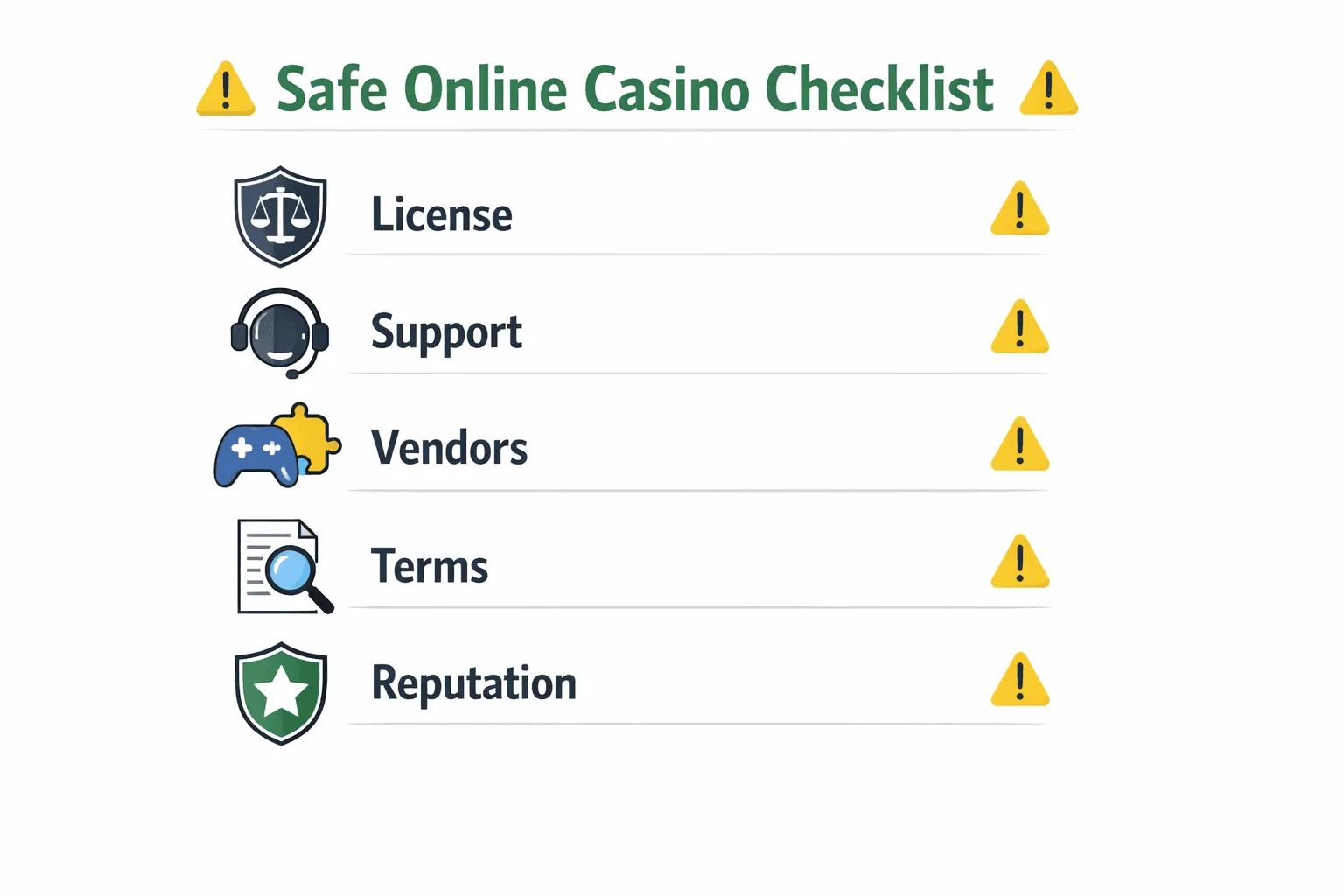
- License: Validated link to a Tier 1 or trusted regulator.
- Support: Live chat is responsive and helpful, not a bot.
- Vendors: Games are hosted by reputable providers (Playtech, Microgaming, etc.).
- Terms: Withdrawal limits are reasonable, and bonus terms are clear. Also watch out for promo traps like “free” offers with tight caps—here’s a breakdown of free spins with max cashout rules so you don’t accidentally forfeit winnings.
- Reputation: No history of non-payment on major gambling forums.
Your safety is your responsibility. If a deal looks too good to be true—like a 400% bonus with no strings attached—it is almost certainly a trap. Stick to regulated brands with a proven track record to keep your online gambling experience fun and safe. For general guidance on safer play (and to avoid common psychological traps), you may also want to read about the gambler’s fallacy.
Related guides
Knowledge Base-
Live Dealer vs. RNG Blackjack: Odds, Speed, and Strategy Compared
Compare Live Dealer vs. RNG Blackjack to find the best odds and speed. Discover how gameplay style, fairness, and strategy differ in this expert guide.
Knowledge Base
-
RTP vs. Volatility: How to Choose the Right Slot for Your Budget
Learn the difference between RTP and volatility in slots. Discover how to choose the right game to maximize your playtime and match your budget.
Knowledge Base
-
Data-Driven Bankroll Management: Using the Kelly Criterion in Online Casinos
Master data-driven bankroll management with the Kelly Criterion. Learn how to optimize bet sizing, manage risk, and maximize growth in online casinos.
Knowledge Base