
Data-Driven Bankroll Management: Using the Kelly Criterion in Online Casinos
Master data-driven bankroll management with the Kelly Criterion. Learn how to optimize bet sizing, manage risk, and maximize growth in online casinos.

In the high-stakes world of online casinos, the difference between a fleeting thrill and a sustainable hobby often comes down to one thing: bankroll management.
While many players rely on gut feelings or superstitious betting patterns, professional gamblers and data analysts turn to mathematics.
Enter the Kelly Criterion, a formula developed by Bell Labs scientist John Kelly, Jr. in 1956, designed to maximize the long-term growth rate of a bankroll. (For background on its information-theory roots, see the original paper listing: A New Interpretation of Information Rate.)

For the modern online casino player, applying a data-driven approach is no longer optional—it is a necessity for longevity. This guide explores how to leverage the Kelly Criterion to make smarter, mathematically sound decisions, balancing the potential for profit against the inevitable risks of variance.
What is the Kelly Criterion?
At its core, the Kelly Criterion is a mathematical formula used to determine the optimal size of a series of bets. It addresses the two main fears of any bettor: betting too little (wasting an advantage) and betting too much (risking ruin).
Unlike flat betting (wagering the same amount every time) or progressive systems like the Martingale (doubling up after losses), the Kelly strategy is proportional. It suggests that your bet size should scale with your edge (advantage) and your bankroll size.
The Formula
While the derivation involves complex calculus and information theory, the practical formula used by gamblers is relatively straightforward:
f* = (bp – q) / b
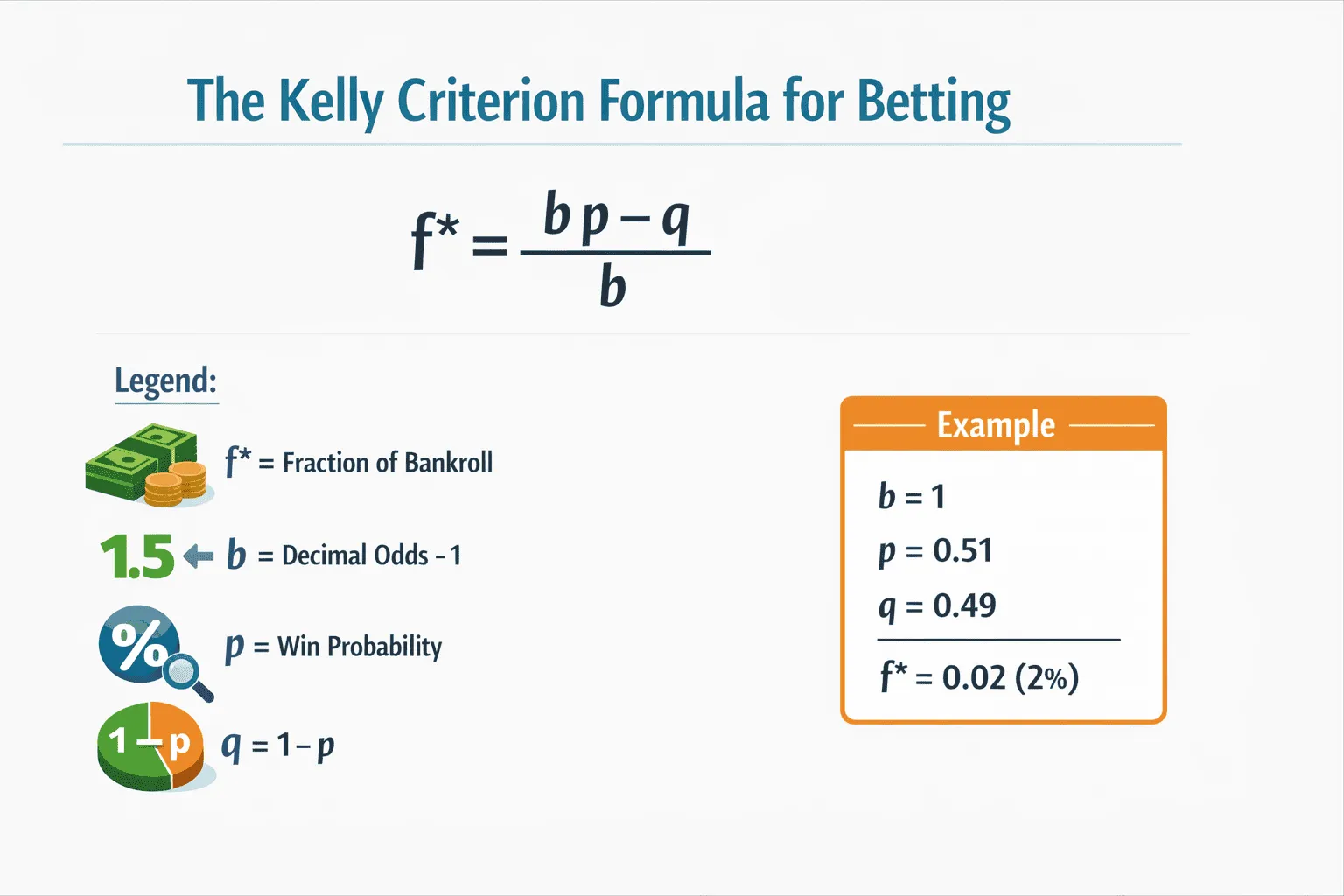
- f* = The fraction of your current bankroll to wager.
- b = The decimal odds – 1 (the net odds received on the wager).
- p = The probability of winning (as a decimal).
- q = The probability of losing (1 – p).
Put simply: (Edge / Odds) = Stake.
The Critical Prerequisite: Positive Expected Value (+EV)
Before applying this formula to your next spin on a slot machine, there is a vital concept you must understand. The Kelly Criterion only works if you have a positive edge.
In data terms, this means the trade must have Positive Expected Value (+EV). If you input the variables of a standard American Roulette game (where the house always has a mathematical edge) into the Kelly formula, the result will be a negative number. Mathematically, the formula is telling you: “Do not bet.” (If you want a deeper explanation of why the house keeps its advantage over time, see why gambling systems fail.)
Therefore, to use the Kelly Criterion effectively in an online casino context, you must be engaging in activities where an edge can be identified, such as:
- Sports Betting: Where your model predicts a higher probability of an outcome than the bookmaker’s odds imply.
- Poker: Where your skill level surpasses that of your opponents.
- Blackjack (with Card Counting): Though difficult online, live dealer games with deep penetration sometimes offer windows of player advantage.
- Bonus Hunting: Utilizing casino promotions, deposit matches, and cashback offers to flip the house edge temporarily in your favor. (Related: how to clear low wagering requirement casino bonuses.)
Applying Kelly to Online Casino Games
If you have identified a +EV opportunity, here is how to apply the data-driven approach to your bankroll.
1. Calculating the Variables
Let’s say you are playing a game or using a bonus strategy where you calculate you have a 2% edge (51% win rate on even money bets).
- b (Odds): 1 (Even money)
- p (Probability of winning): 0.51
- q (Probability of losing): 0.49
Using the formula: (1 * 0.51 – 0.49) / 1 = 0.02
The Kelly Criterion suggests you should wager 2% of your total bankroll on this specific bet to maximize growth.
2. Dynamic Sizing
The beauty of the Kelly Criterion is its dynamic nature. If you lose that bet, your bankroll decreases. Consequently, your next bet (2% of the new total) will be smaller in absolute terms. If you win, your bankroll grows, and your next bet increases. This built-in mechanism acts as a brake during losing streaks and an accelerator during winning streaks.
Risk Management: The Case for “Fractional Kelly”
While the “Full Kelly” approach is mathematically optimal for maximum growth, it is extremely volatile. In the real world, calculating your “true” win probability (p) is often an estimate, not a certainty. Overestimating your edge can lead to disastrous aggressive betting.

Furthermore, full Kelly betting can suggest wagers that are psychologically uncomfortable. Seeing your bankroll swing by 20% or 30% in a single session requires a stomach of steel. To mitigate this, savvy data-driven players use Fractional Kelly. (More broadly, this sits inside good risk management in gambling.)
- Half-Kelly: You calculate the optimal stake and cut it by 50%. This reduces variance significantly while still retaining 75% of the growth potential.
- Quarter-Kelly: You bet 25% of the suggested amount. This is a very conservative approach, ideal for protecting a bankroll while still seeking growth.
Using Kelly Concepts for Negative Edge Games
Most readers playing slots, roulette, or baccarat are playing games with a negative house edge. Can the Kelly Criterion still help? Yes, but as a philosophy rather than a direct formula.
The “Entertainment Cost” Model
Since the formula returns a negative value for these games, a strictly mathematical player would not play. However, if you play for entertainment, you can view your bankroll management through a Loss Limiting lens.
Instead of trying to grow wealth (which is statistically unlikely in negative EV games), use the principles of bankroll division to extend playtime. Allocating a fixed tiny percentage (e.g., 0.1% or 0.5%) of your entertainment budget per spin ensures that even a terrible run of luck won’t wipe you out in minutes. To ground your expectations, it helps to understand casino odds, RTP, and the house edge.
Setting Up Your Data-Driven System
To implement a professional-grade bankroll strategy, follow these steps:
- Segregate Funds: Your casino bankroll must be separate from your life expenses. This is the capital ‘B’ in the formula.
- Determine Your Edge: Be honest. If you cannot mathematically prove you have an edge (e.g., via a specific sports model or bonus term), assume the edge belongs to the house and bet conservatively.
- Choose Your Fraction: For most players, Quarter-Kelly is the sweet spot. It offers growth without the heart-stopping volatility.
- Recalculate Often: In online casinos, the speed of play is fast. You don’t need to recalculate after every hand, but you should adjust your bet size after every session based on your new bankroll total.
Responsible Gambling and Variance
It is vital to remember that the Kelly Criterion is a long-term strategy. In the short term, variance reigns supreme. Even with a mathematical edge and perfect bet sizing, you can experience losing weeks or months.
It also helps to understand the psychological traps that can derail otherwise “math-based” decisions (e.g., illusion of control, availability bias, and other decision-making distortions). Read more on how cognitive biases show up in gambling behavior here: Cognitive biases and decision making in gambling (PubMed). For a deeper look at how gambling environments shape decisions, see the psychology of gambling.
Important: Never use the Kelly Criterion to justify chasing losses. The formula requires you to reduce stakes when losing, not increase them. If you find yourself increasing bets to “win it back,” you have abandoned the math and entered the realm of emotional gambling. (Related misconception: the Gambler’s Fallacy.)
If you want a practical, player-focused checklist for staying within limits (time/money caps, self-exclusion options, and responsible gaming program expectations), see: National Council on Problem Gambling — Responsible Gaming Principles. You can also review our responsible gambling guide.
Conclusion
Data-driven bankroll management transforms online casino gaming from a chaotic gamble into a disciplined pursuit. The Kelly Criterion provides a robust framework for those rare situations where players can find an edge, such as sports betting or strategic bonus use. By understanding the relationship between your edge, the odds, and your bet size, you can protect your funds and give yourself the best mathematical chance at long-term success.
Disclaimer: All forms of gambling carry financial risk. The strategies discussed here are mathematical concepts and do not guarantee winnings. House edges in casino games generally ensure the casino wins over time. Always gamble responsibly and never wager money you cannot afford to lose.
Related guides
Knowledge Base-
Live Dealer vs. RNG Blackjack: Odds, Speed, and Strategy Compared
Compare Live Dealer vs. RNG Blackjack to find the best odds and speed. Discover how gameplay style, fairness, and strategy differ in this expert guide.
Knowledge Base
-
RTP vs. Volatility: How to Choose the Right Slot for Your Budget
Learn the difference between RTP and volatility in slots. Discover how to choose the right game to maximize your playtime and match your budget.
Knowledge Base
-
How to Clear Wagering Requirements: A Low-Volatility Strategy Guide
Unlock your casino bonus with our low-volatility strategy. Learn to clear wagering requirements using high RTP slots and smart risk management to keep your winnings.
Knowledge Base