
Live Dealer vs. RNG Blackjack: Odds, Speed, and Strategy Compared
Compare Live Dealer vs. RNG Blackjack to find the best odds and speed. Discover how gameplay style, fairness, and strategy differ in this expert guide.

In the world of online casinos, blackjack remains the undisputed king of table games. However, modern players face a choice that didn’t exist two decades ago: Live Dealer or RNG (Random Number Generator) Blackjack? While the goal of getting to 21 without busting remains the same, the experience, pacing, and strategy dynamics differ significantly between the two.
Choosing the right version isn’t just about preference; it impacts your hourly win rate, your ability to use strategy, and your bankroll management. This guide breaks down the technical and practical differences to help you decide which version offers the better edge for your playstyle. If you’re new to iGaming overall, you may also want to start with our Beginner’s Guide to Online Gambling.

What is RNG Blackjack?
RNG Blackjack is the digital, software-based version of the game. It is powered by a Random Number Generator—a complex algorithm that ensures every card dealt is entirely random and independent of the previous hand. Visually, it looks like a video game with computer-generated graphics representing the table and cards.
How It Works
In RNG games, the “deck” is effectively shuffled after every single round. There is no physical shoe of cards. Instead, the software selects cards from a virtual infinite deck (or a set number of decks that are instantly reset) the moment you hit the “Deal” button. For a deeper explanation of the tech behind RNGs and casino algorithms, see How Online Casinos Really Work: RNGs, Algorithms, and the House Edge.
The Pros of RNG Blackjack
- Unmatched Speed: You control the pace. You can play a hand in seconds, making it ideal for volume players looking to maximize hands per hour.
- Lower Minimum Bets: Because there are no staff costs (dealers, pit bosses, camera crew), RNG tables often allow bets as low as $0.10 or $1.00.
- Practice Mode: Most RNG games offer a “free play” or demo mode, allowing beginners to learn basic strategy charts without risking real money.
- Zero Distractions: It is just you and the software. There is no chat box, no waiting for other players to act, and no time limits on your decisions.
What is Live Dealer Blackjack?
Live Dealer Blackjack bridges the gap between a brick-and-mortar casino and online play. High-definition cameras stream a human dealer managing a physical table in real-time. You place bets via a digital interface, but the cards, table, and shuffle are real.

How It Works
Live games use Optical Character Recognition (OCR) technology. As the dealer pulls a card from the shoe, it passes over a scanner that reads the value and displays it on your screen instantly. This combines the trustworthiness of physical cards with the convenience of digital betting.
The Pros of Live Dealer Blackjack
- Immersive Atmosphere: It replicates the social environment of a casino. You can chat with the dealer and sometimes other players.
- Trust and Transparency: Many players are skeptical of algorithms. Seeing a human shuffle and deal cards provides a psychological sense of fairness.
- Memory Dependent Play: Unlike RNG, live games use a physical shoe (often 6 to 8 decks). While card counting is difficult due to cut cards, the shoe is not shuffled every single hand (unless a Continuous Shuffling Machine is used).
The Odds: Which Version Pays Better?
A common misconception is that one format is “rigged” or looser than the other. In reality, the House Edge is determined by the specific rules of the table, not whether it is Live or RNG. If you want to understand how house edge and RTP work across casino games (and why they matter more than “luck”), read Understanding Casino Odds, RTP & House Edge.
However, you are more likely to find favorable rules in RNG Blackjack for one specific reason: variety.
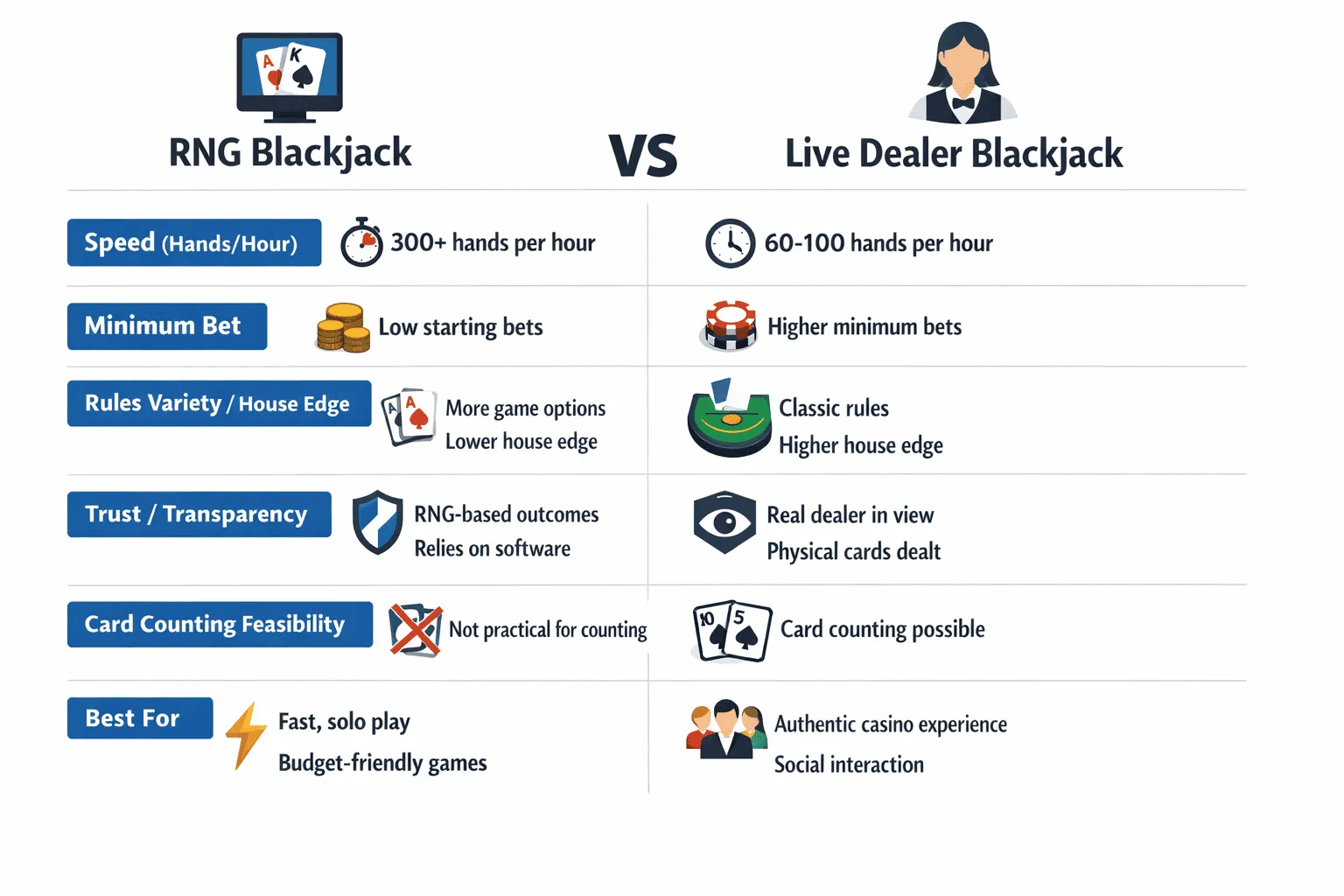
Rule Variations in RNG
Online casinos can host hundreds of RNG variants at zero extra cost. You can easily find games with:
- Single Deck Blackjack (lowest house edge if payouts remain 3:2).
- Surrender options (Early or Late).
- Double down on any two cards.
- Dealer stands on Soft 17.
Because of this variety, a savvy player can hunt for an RNG table with a house edge as low as 0.3% to 0.5%.
Rule Variations in Live Dealer
Live Dealer tables have limited physical space and higher overhead. Consequently, they tend to standardize rules to maintain a steady house edge (usually around 0.5% to 0.7%). You will often encounter:
- 8 Decks (increases house edge slightly).
- Dealer hits on Soft 17 (unfavorable to player).
- Higher minimum bets ($5 to $25+).
Winner: RNG Blackjack slightly edges out Live Dealer because it is easier to find specific rule sets that favor the player, such as Single Deck or Surrender options.
Speed of Play: Hands Per Hour
If your goal is to grind through a bonus wagering requirement or maximize theoretical returns, speed is a critical factor.
RNG: The Speed Demon
In RNG blackjack, you are the only variable. If you play fast, the game moves fast. An experienced player can easily clear 200+ hands per hour. This allows for rapid execution of basic strategy and quick realization of long-term math.
Live Dealer: The Social Pace
Live blackjack is inherently slower. The dealer must wait for all players to place bets, deal physical cards, wait for each player to make a decision (Hit, Stand, Double), and then settle bets. You are lucky to see 50 to 60 hands per hour. If you are at a “Common Draw” table (where one hand is dealt to hundreds of players), the speed improves slightly but still lags behind RNG.
Winner: RNG Blackjack is the clear winner for speed.
Fairness and Trust
This is the most debated aspect among players. “Is the computer cheating?” is a question often asked of RNG games. It also ties into broader myths that persist in casino gambling—see Common Gambling Myths (and Why They’re Wrong): The Science Behind the House Edge.
RNG Audits
Legitimate online casinos use RNG software audited by third-party testing agencies like eCOGRA or iTech Labs. These audits verify that the card distribution is statistically random over millions of hands. However, the lack of visual confirmation can leave some players feeling uneasy during a losing streak. If that sounds familiar, it can help to understand common “pattern-seeking” thinking errors—read more about gambler’s fallacy vs. hot-hand beliefs in a peer-reviewed behavioral decision-making journal.
Live Dealer Visibility
Live Dealer games offer visual proof. You see the shuffle (or the shoe change) and the deal. However, beware of Continuous Shuffling Machines (CSMs). Many live dealer tables use these machines to recycle used cards back into the deck immediately. This makes card counting impossible and effectively mimics the randomness of an RNG, negating the “physical shoe” advantage.
Winner: Tie. Both are fair at regulated casinos, but Live Dealer wins on perception of trust, while RNG wins on statistical consistency.
Card Counting and Strategy
Can you count cards online? Generally, no—but the reason differs.
In RNG Blackjack: The deck is shuffled after every hand. The “count” is reset to zero constantly. Card counting is mathematically useless here.
In Live Dealer Blackjack: While there is a shoe, casinos counter counters by using:
- Poor Penetration: The dealer puts the cut card in the middle of the shoe, cutting off half the deck. This prevents the “true count” from ever getting high enough to be profitable.
- CSMs: As mentioned, machines that shuffle continuously.
- Slow Play: The low number of hands per hour makes counting incredibly inefficient, even if the penetration was good.
It’s also worth remembering that our brains naturally try to “see” streaks and meaning in random sequences—an effect that can influence decisions like pressing bets after losses or assuming a win is “due.” For a research-based look at why people believe in streaks (and when streaks can or can’t be real), see this explainer from Stanford Graduate School of Business / Stanford Report. For a more casino-specific breakdown of this bias, you can also read What is the Gambler’s Fallacy?.
Winner: Live Dealer (Technically). While highly ineffective, it is theoretically possible to track a shoe in Live Dealer games that don’t use CSMs, whereas it is impossible in RNG.
Summary: Which Version Should You Play?
The choice ultimately depends on what you value most in your gaming session.
Choose RNG Blackjack if:
- You want the best possible odds (by finding specific rule variants).
- You have a smaller bankroll (micro-stakes available).
- You want to play fast and maximize hands per hour.
- You are learning Basic Strategy and want no pressure.
Choose Live Dealer Blackjack if:
- You crave the social interaction and casino atmosphere.
- You distrust computer algorithms and prefer physical cards.
- You are a high roller (Live tables often have higher maximum limits).
- You enjoy a slower, more deliberate pace of play.
Both versions offer the potential for profit if you adhere to strict Basic Strategy. We recommend starting with RNG to sharpen your skills and moving to Live Dealer when you want to enjoy the entertainment value of the casino floor from the comfort of your home. For a realistic bigger-picture comparison (and to set expectations), see Slots vs. Table Games: A Realistic Guide to Risk, Skill, and Expectations.
Responsible play note: Whichever format you choose, it helps to set time and spending limits in advance and stick to them—especially in faster-paced RNG sessions. For practical tips and tools, read our Responsible Gambling Guide: Limits, Risks & Safety Tips. If gambling stops feeling fun or starts affecting your finances, relationships, or mood, you can find confidential support and resources via the National Council on Problem Gambling (NCPG).
Related guides
Knowledge Base-
RTP vs. Volatility: How to Choose the Right Slot for Your Budget
Learn the difference between RTP and volatility in slots. Discover how to choose the right game to maximize your playtime and match your budget.
Knowledge Base
-
Data-Driven Bankroll Management: Using the Kelly Criterion in Online Casinos
Master data-driven bankroll management with the Kelly Criterion. Learn how to optimize bet sizing, manage risk, and maximize growth in online casinos.
Knowledge Base
-
How to Clear Wagering Requirements: A Low-Volatility Strategy Guide
Unlock your casino bonus with our low-volatility strategy. Learn to clear wagering requirements using high RTP slots and smart risk management to keep your winnings.
Knowledge Base