The Psychology of Gambling: Why Casinos Feel So Engaging | Deep Dive
Discover the psychology of gambling, from dopamine loops and near-misses to sound design. Learn why casinos are engineered to keep you engaged.

Have you ever walked into a casino and felt an immediate shift in your mood? The lights, the sounds, and the energy create an atmosphere that feels distinct from the outside world. It turns out, this isn’t an accident. The engaging nature of casinos—and modern digital gambling platforms—is the result of decades of psychological research and meticulous design.

While luck determines the outcome of a spin or a hand, psychology determines why we keep playing. By leveraging cognitive biases, sensory cues, and the brain’s natural reward systems, the gambling industry creates an environment optimized for engagement. Understanding these mechanisms isn’t just fascinating; it’s essential for maintaining a healthy relationship with gaming. (For practical bankroll advice, see our guide on risk management in gambling.)
This article explores the neuroscience and psychology behind why gambling feels so compelling, breaking down the specific tactics used to maintain player interest.
The Neuroscience of the “Win”: Dopamine and Reward Loops
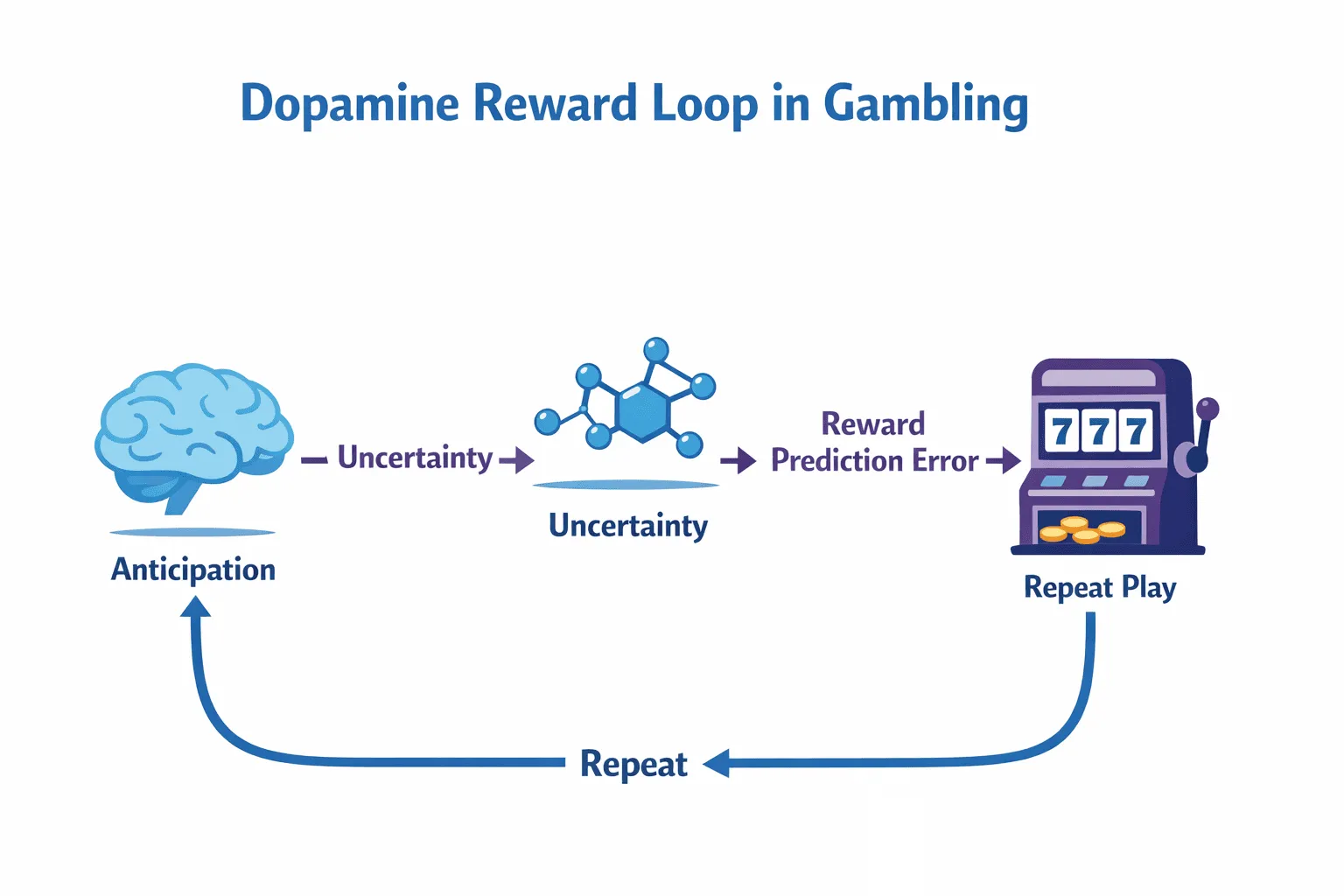
At the core of gambling’s appeal is the brain’s reward system, specifically the neurotransmitter dopamine. Often misunderstood as the “pleasure molecule,” dopamine is actually about anticipation and motivation. It is the chemical signal that tells your brain, “Do that again, it might lead to a reward.”
The Power of Uncertainty
You might assume that winning causes the biggest spike in dopamine. However, research suggests that uncertainty is the true driver of engagement. This concept was famously demonstrated by psychologist B.F. Skinner in the 1950s using what is now known as the “Skinner Box.”
Skinner discovered that lab rats pressed a lever more compulsively when they received a treat randomly (Variable Ratio Reinforcement) rather than every time (Fixed Ratio Reinforcement). If a reward is predictable, the brain loses interest. If the reward is unpredictable, the brain remains in a state of hyper-arousal, constantly seeking the pattern. Read more about variable-ratio reinforcement schedules in operant conditioning.
Slot machines are the perfect real-world application of this principle. You never know if the next spin will be a bust, a small payout, or a jackpot. This unpredictability keeps the dopamine flowing, even during a losing streak. If you want to go deeper on improving your fundamentals, check out these slots strategy and tips.
The Near-Miss Effect: Why Almost Winning Feels Like Winning
One of the most powerful psychological tools in gambling is the near-miss. This occurs when the outcome creates the perception that you were incredibly close to a jackpot—for example, getting two “7s” on the payline with the third “7” just barely clicking past to the next position.
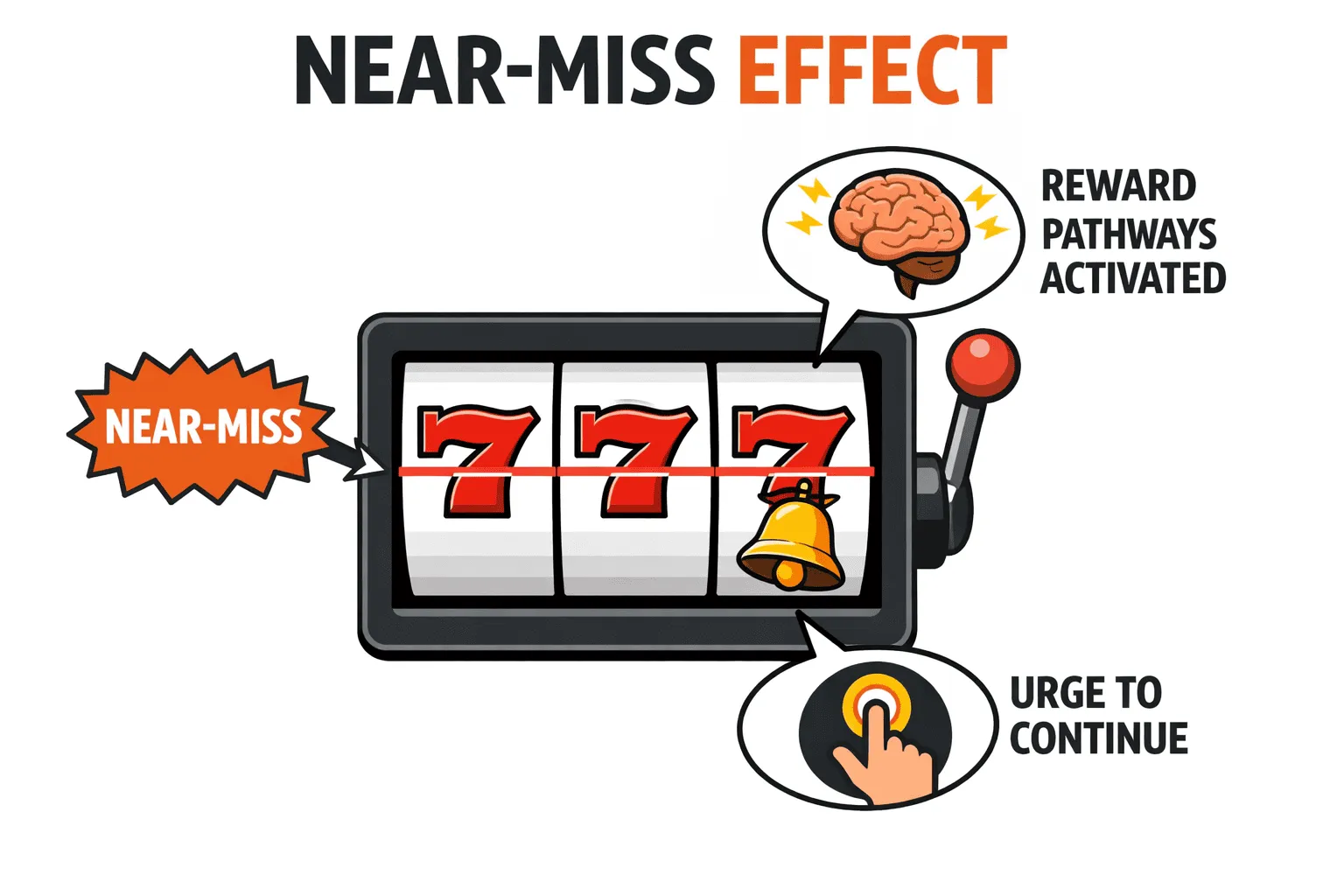
To the rational mind, a near-miss is a loss. Mathematically, landing one symbol away from a jackpot pays out the exact same amount as landing on a blank space: zero. However, the human brain interprets it differently.
- The Biological Response: fMRI studies have shown that near-misses can recruit reward-related brain circuitry (including areas that respond to monetary wins), helping explain why “almost” can feel motivating. For deeper reading, see the open-access paper Gambling Near-Misses Enhance Motivation to Gamble and Recruit Win-Related Brain Circuitry (Neuron).
- Skill vs. Chance: In games of skill (like archery), a near-miss provides useful feedback (“I need to aim slightly higher”). In games of pure chance (like slots or roulette), a near-miss provides no useful information, yet our brains struggle to distinguish between the two.
Designing the Sound of Success
If you were to mute a casino floor, the experience would change drastically. Sound design plays a pivotal role in reinforcing the reward loop and masking losses.
Auditory Conditioned Reinforcement
Casinos utilize specific soundscapes to create positive associations. Winning sounds are typically composed in the key of C major, which is culturally perceived as happy and resolving. These sounds are often loud, distinct, and celebratory.
Conversely, losing is usually silent. There is no buzzing “wrong answer” sound when a spin doesn’t pay out; the machine simply stops. This asymmetry is crucial. If every loss were accompanied by a negative sound, players would be constantly reminded of how often they are losing. Silence allows the loss to slide by unnoticed, while the wins—even small ones—are amplified.
Losses Disguised as Wins (LDWs)
Modern multi-line slot machines have introduced a phenomenon known as Losses Disguised as Wins. This happens when a player bets, say, $5 on a spin and wins back $3. The machine celebrates this event with flashing lights and triumphant music, treating it as a victory.
In reality, the player has lost $2. However, the sensory feedback tricks the brain into categorizing the event as a win, sustaining the dopamine loop and reducing the pain of the financial loss. This keeps players engaged for longer periods, as they feel they are “winning” frequently, even as their bankroll slowly depletes. Read more about the research on “losses disguised as wins” (LDWs) in modern multi-line slot machines.
Cognitive Biases: The Tricks Your Brain Plays
Beyond the external design of games, our own internal cognitive biases make us susceptible to the allure of gambling. Two specific biases stand out in the context of casinos.
The Gambler’s Fallacy
The Gambler’s Fallacy is the erroneous belief that if a particular event occurs more frequently than normal during the past, it is less likely to happen in the future (or vice versa).
For example, if a Roulette ball lands on “Red” five times in a row, many players feel an overwhelming urge to bet on “Black,” believing it is “due.” In reality, every spin of the wheel is an independent event. The wheel has no memory; the odds of Red or Black remain exactly the same regardless of previous outcomes. Read more: what is the gambler’s fallacy? (also known as the fallacy of the maturity of chances).
The Illusion of Control
Humans have a deep-seated need to feel in control of their environment. Gambling games often include features that simulate control where none exists.
- Craps: Players throw the dice themselves.
- Slots: Some machines have “stop” buttons that let players halt the reels early. While the outcome is determined the nanosecond the spin button is pressed, the ability to “stop” the reels makes players feel their skill is influencing the result.
- Card Picking: Allowing a player to “choose” a card or a mystery box creates a sense of agency, even if the choice is effectively random.
Environmental Design: The “Zone”
The physical layout of a casino is engineered to facilitate a state of deep immersion, often referred to by researchers as “The Zone” or a “Flow State.”
Removing Temporal Cues
It is a well-known trope that casinos lack clocks and windows. While this is less true in some modern resorts that emphasize natural light, the principle remains: the goal is to detach the player from the passage of time. Without external cues (like the sun setting), players are less likely to feel the urgency to leave.
The Maze Layout
Casino floors are often designed as a labyrinth of high-value machines and tables, with amenities like restrooms and cashier cages located deep within the facility. This layout forces patrons to navigate past tempting gaming options to reach basic services.
The Ethics of Engagement and Responsible Gambling
Understanding the psychology of gambling transforms it from a mysterious compulsion into a logical interaction between design and biology. However, because these mechanisms bypass our rational decision-making, they carry inherent risks.
For most people, gambling is a form of entertainment—paying for the thrill of the “what if.” But for a percentage of the population, the reward loops discussed above can lead to addiction. The same dopamine pathways hijacked by gambling are those involved in substance dependence.
Recognizing the Signs
If you choose to gamble, maintaining awareness of these psychological triggers is your best defense. Ask yourself:
- Am I chasing the feeling of a “near-miss”?
- Am I interpreting “losses disguised as wins” as actual victories?
- Am I falling for the Gambler’s Fallacy by thinking a win is “due”?
If you want a practical framework for staying in control, you may also like: 10 proven gambling strategies to boost your odds.
Note: If you or someone you know is struggling with gambling addiction, resources are available. Organizations like the National Council on Problem Gambling provide confidential support and tools to help regain control. You can find help via the National Council on Problem Gambling’s support and treatment resources.
Conclusion
Casinos feel engaging not because of magic, but because of mastery—mastery of human psychology. From the variable rewards that keep our dopamine spiking to the sound design that celebrates even partial victories, every element is crafted to maximize engagement. By understanding the science behind the glitz and glamour, players can make more informed choices, viewing the casino floor not as a realm of pure chance, but as a carefully constructed experience. If you’re looking for places to play, browse our online casinos hub.
Related guides
Knowledge Base-
Live Dealer vs. RNG Blackjack: Odds, Speed, and Strategy Compared
Compare Live Dealer vs. RNG Blackjack to find the best odds and speed. Discover how gameplay style, fairness, and strategy differ in this expert guide.
Knowledge Base
-
RTP vs. Volatility: How to Choose the Right Slot for Your Budget
Learn the difference between RTP and volatility in slots. Discover how to choose the right game to maximize your playtime and match your budget.
Knowledge Base
-
Data-Driven Bankroll Management: Using the Kelly Criterion in Online Casinos
Master data-driven bankroll management with the Kelly Criterion. Learn how to optimize bet sizing, manage risk, and maximize growth in online casinos.
Knowledge Base