The Psychology of ‘Tilt’: Recognizing and Stopping Emotional Betting
Master the psychology of tilt in betting. Recognize triggers, stop chasing losses, and regain control of your bankroll effectively.

In the high-stakes world of sports betting and poker, there is an invisible adversary that has drained more bankrolls than bad luck or poor strategy ever could. It isn’t the house edge, and it isn’t a rigged game. It is a psychological state known as “tilt.”
Every bettor, from the casual weekend warrior to the seasoned sharp, has felt its pull. It’s that surge of frustration after a bad beat, the burning desire to “make it back” immediately, and the sudden abandonment of logic in favor of impulse. Understanding the psychology of tilt isn’t just about protecting your money, it is about mastering your own mind.
This guide explores the neuroscience behind emotional betting, helps you identify the warning signs, and provides actionable, professional strategies to stop tilt in its tracks. (If you want a broader foundation first, see our Beginner’s Guide to Online Gambling.)

What is ‘Tilt’?
The term “tilt” originated in pinball arcades. If a player became too aggressive and physically shook the machine to influence the ball, the machine would register a “TILT” error and freeze the flippers. The game was over because the player had lost control.
In gambling, the definition is strikingly similar. Tilt is a state of mental or emotional confusion or frustration in which a player adopts a less than optimal strategy.
While often associated with anger, tilt can manifest as:
- Desperation: Trying to recover losses quickly.
- Overconfidence: Betting too high after a winning streak (often called “winning tilt”).
- Apathy: Losing respect for the value of money after a long session.
The Neuroscience of Emotional Betting
To stop tilt, you must first understand that it is a biological response, not just a character flaw. When you experience a “bad beat”, like a last-minute goal ruining your parlay, your brain reacts similarly to physical danger. (Related: how gambling environments are engineered to keep you engaged in The Psychology of Gambling: Why Casinos Feel So Engaging.)
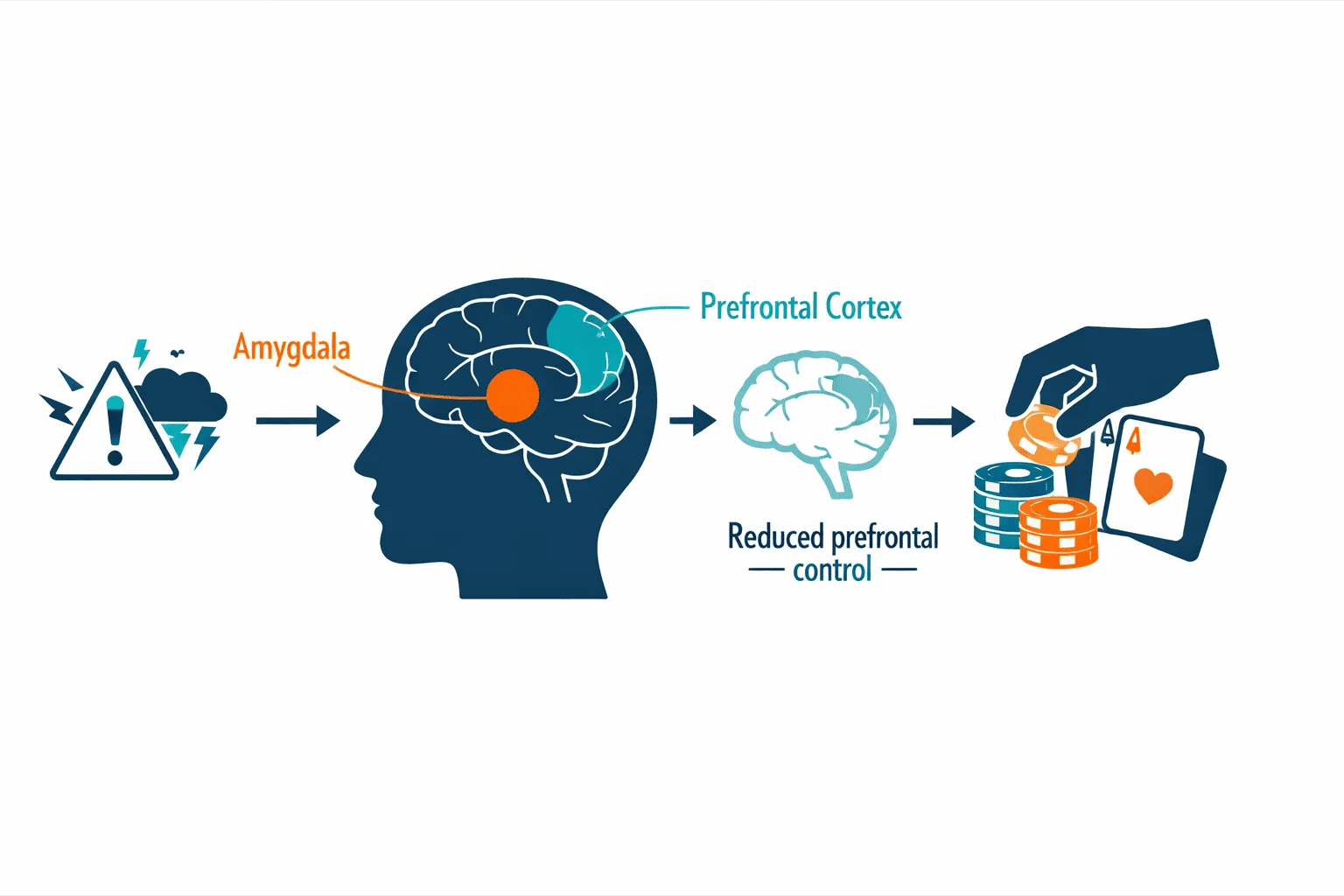
The Amygdala Hijack
The amygdala is the part of the brain responsible for the “fight or flight” response. When triggered by the stress of a loss, it can override the prefrontal cortex, the area responsible for logic, risk assessment, and long-term planning.
Psychologists call this an amygdala hijack. In this state, your brain literally shuts down its rational processing centers. You are no longer making decisions based on probability or handicapping; you are making decisions based on a chemical need to relieve distress. This is why bettors on tilt often look back at their bet history the next day and wonder, “What was I thinking?” The answer is: biologically, you weren’t.
Recognizing the Signs of Tilt
Tilt is insidious because it often feels justified in the moment. You might convince yourself you are “due” for a win or that a specific bet is a “lock.” Recognizing the symptoms early is your best defense. (This “due” feeling is closely related to the Gambler’s Fallacy and the Fallacy of the Maturity of Chances.)
Physical Signs
- Elevated Heart Rate: A pounding chest during a mundane wager.
- Physical Heat: Feeling your face flush or body temperature rise.
- Tension: Clenching your jaw, fists, or mouse.
Behavioral Signs
- Chasing Losses: Placing a new bet immediately after a loss to win back the money.
- Increasing Stakes: Betting larger amounts than your bankroll management strategy allows.
- Betting on Unknowns: Wagering on sports or leagues you know nothing about just to have “action.”
- Refreshing Scores Obsessively: An inability to look away from a game.
The Psychology of Chasing Losses
The engine that drives tilt is a cognitive bias known as Loss Aversion. Behavioral economists have found that the pain of losing $100 is roughly twice as intense as the pleasure of winning $100. We are hardwired to avoid pain. (If you want to go deeper, see how prospect theory explains why people become more risk-seeking when they’re “in the domain of losses.”)
When you lose, your brain seeks to eliminate that pain immediately. The quickest way to do that, it reasons, is to win the money back. This leads to “The Chasing Spiral”:
- The Trigger: An unexpected or painful loss occurs.
- The Reaction: Emotional distress (loss aversion) kicks in.
- The Deviation: You abandon your strategy to place a high-risk “recovery” bet.
- The Result: Often, another loss, which intensifies the distress and restarts the cycle with higher stakes.
How to Stop Tilt: Actionable Strategies
Stopping tilt requires preparation before the emotional event occurs. Once the amygdala hijack begins, it is difficult to stop without pre-set guardrails.

1. Establish Strict Bankroll Management
This is the single most effective tool against emotional betting. Determine your “unit” size (typically 1-3% of your total bankroll) and never deviate from it, regardless of how confident you feel. For a more complete framework, read Risk Management in Gambling.
- The Rule: If you lose a bet, your next bet size does not change.
- The Benefit: It removes the decision-making process from the heat of the moment.
2. Set “Stop-Loss” Limits
Just as stock traders set stop-loss orders to prevent catastrophic losses, bettors should have a hard cap for the day or week. If you lose X amount, you are done for the day. Period.
This limit protects you from the “one more bet” syndrome. When you hit your limit, close the app, turn off the game, and walk away. (You may also like: Responsible Gambling Guide: Limits, Risks & Safety Tips.)
3. The HALT Method
Never gamble if you are:
- Hungry
- Angry
- Lonely
- Tired
These physical and emotional states lower your willpower and make the prefrontal cortex weaker against emotional impulses.
4. Practice “Tactical Breathing”
If you feel the physical signs of tilt (heat, rapid heartbeat), force a reset. Tactical breathing is a technique used by high-stress professionals to calm the nervous system.
- Breathe in for 4 seconds.
- Hold for 4 seconds.
- Exhale for 4 seconds.
- Hold for 4 seconds.
Doing this for one minute can re-engage your rational brain.
5. Keep a Betting Journal
Track not just your bets, but your mood. Write down why you made a bet. If you find yourself writing “to win back the last loss,” you have objective proof that you are on tilt. Reviewing this journal helps you identify your personal triggers.
Mastering the Mental Game
You cannot control the outcome of a game, a race, or a hand of cards. You can only control your decisions. Tilt is the surrender of that control.
By recognizing the biological reality of emotional betting and implementing strict financial and behavioral guardrails, you transform from a gambler who relies on luck to a bettor who relies on discipline.
Remember, the goal of betting is to make correct decisions, not just to win money. If you make the correct decisions consistently, the results will follow. If you’re unsure whether gambling is still fun or starting to become risky, read When to Walk Away: Knowing the Difference Between Entertainment and Risk.
Frequently Asked Questions
What is the difference between ‘steaming’ and ’tilting’?
While often used interchangeably, “steaming” usually refers to a specific type of tilt where a player becomes angry and aggressively bets on anything to release frustration. Tilt is the broader term for any emotional state that disrupts optimal strategy.
Can winning cause tilt?
Yes. “Winning tilt” or “entitlement tilt” occurs when a bettor goes on a hot streak and begins to believe they cannot lose. This leads to overconfidence, looser bet selection, and increasing stakes, often resulting in giving back all profits.
How long should I take a break if I’m on tilt?
It depends on the severity. For minor frustration, a 15-minute walk might suffice. For severe tilt where you have lost significant money, a break of at least 24 to 48 hours is recommended to allow the neurochemical “fog” to clear.
Is tilt a sign of gambling addiction?
Frequent, uncontrollable tilt that leads to financial harm can be a sign of problem gambling. If you find you cannot stop even when you want to, or if you are betting money you cannot afford to lose, seek help immediately. In the U.S., the National Council on Problem Gambling offers confidential support and referrals via the National Problem Gambling Helpline (call, text, or chat options available).
Related guides
Knowledge Base-
Live Dealer vs. RNG Blackjack: Odds, Speed, and Strategy Compared
Compare Live Dealer vs. RNG Blackjack to find the best odds and speed. Discover how gameplay style, fairness, and strategy differ in this expert guide.
Knowledge Base
-
RTP vs. Volatility: How to Choose the Right Slot for Your Budget
Learn the difference between RTP and volatility in slots. Discover how to choose the right game to maximize your playtime and match your budget.
Knowledge Base
-
Data-Driven Bankroll Management: Using the Kelly Criterion in Online Casinos
Master data-driven bankroll management with the Kelly Criterion. Learn how to optimize bet sizing, manage risk, and maximize growth in online casinos.
Knowledge Base