
RTP vs. Volatility: How to Choose the Right Slot for Your Budget
Learn the difference between RTP and volatility in slots. Discover how to choose the right game to maximize your playtime and match your budget.
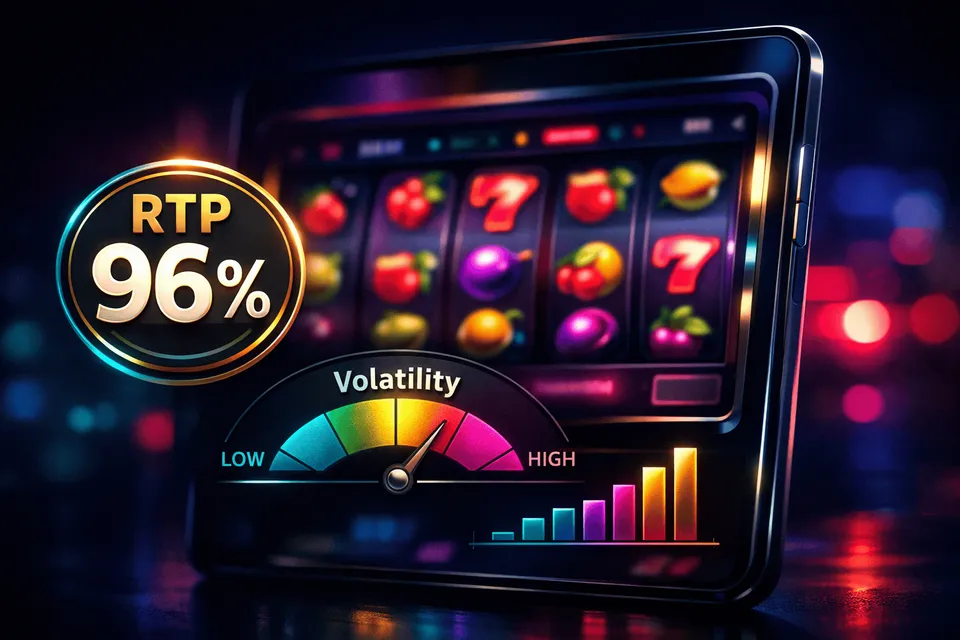
Walking into an online casino—or browsing one on your phone—can feel like entering a cockpit with a thousand blinking buttons. You see flashy themes, jackpot tickers, and two technical terms thrown around constantly: RTP and Volatility.

Most players ignore these numbers, picking games based on graphics alone. But if you want to extend your playtime and give your budget a fighting chance, understanding these two metrics is non-negotiable.
This guide cuts through the jargon. We will explain exactly how RTP and volatility interact, and more importantly, how to pick the right combination for your specific bankroll.
What is RTP? (Return to Player)
RTP stands for Return to Player. It is a percentage that indicates how much of the money wagered on a slot machine is paid back to players over time. If you want a deeper breakdown (including how RTP ties into the house edge), see our guide on understanding casino odds, RTP & house edge.
For example, if a slot has an RTP of 96%, it means that for every $100 wagered, the machine is programmed to return $96 to players theoretically.
The “Long-Term” Catch
The most common mistake players make is thinking RTP applies to their specific session. It does not.
- RTP is calculated over millions of spins.
- In a short session, anything can happen. You could win $1,000 from a $10 spin, or lose $50 in ten minutes.
- The remaining percentage (e.g., 4%) represents the House Edge—the casino’s mathematical advantage. If you want the math-focused explanation of why the casino advantage wins out over time, read why gambling systems fail over time.
Key Takeaway: A higher RTP (96%+) is generally better, but it doesn’t guarantee you will win today.
Read more about how RTP is defined and why it reflects collective, long-run results (not one player’s session) here: Return to Player (RTP) explained.
What is Volatility? (Variance)
While RTP tells you how much a slot pays back, Volatility (often called Variance) tells you how it pays it back. For a full, player-friendly explanation (and why two people can have wildly different sessions on the same game), see game volatility & variance explained.
Volatility measures the risk involved in playing a specific slot. It defines the frequency and size of payouts.
If you want the plain-language stats meaning of “variance” (how spread out outcomes are), this reference is helpful: Variance (statistics) definition.
The 3 Levels of Volatility
- Low Volatility:
- Behavior: Frequent wins, but usually small amounts.
- Experience: Your bankroll fluctuates gently. You get plenty of “feedback” from the game (lights, sounds, small coin splashes).
- Best for: Fulfilling wagering requirements or playing for entertainment without losing money quickly. If you’re clearing playthrough, you’ll also like our step-by-step guide on how to clear low wagering requirement casino bonuses.
- Medium Volatility:
- Behavior: A balance between frequency and payout size.
- Experience: You might go a few spins without a win, but the payouts tend to be significant enough to top up your balance.
- Best for: The average player who wants a shot at a decent win but doesn’t want to burn through cash instantly.
- High Volatility:
- Behavior: Rare wins, but potentially massive payouts.
- Experience: Expect “dry spells” or “dead spins.” You might spin 20 or 50 times with zero return, followed by a massive bonus round that pays 1,000x your stake.
- Best for: Jackpot hunters and high-risk players. If you want a broader comparison of what to expect from different casino games (and where skill matters), read slots vs. table games: risk, skill, and expectations.
RTP vs. Volatility: The Relationship
Think of RTP as the size of the pie, and Volatility as how the pie is sliced.
- Slot A (Low Volatility): The pie is cut into 100 small slices. Everyone gets a crumb frequently.
- Slot B (High Volatility): The pie is cut into 4 huge slices. Most people get nothing, but the winners get a feast.
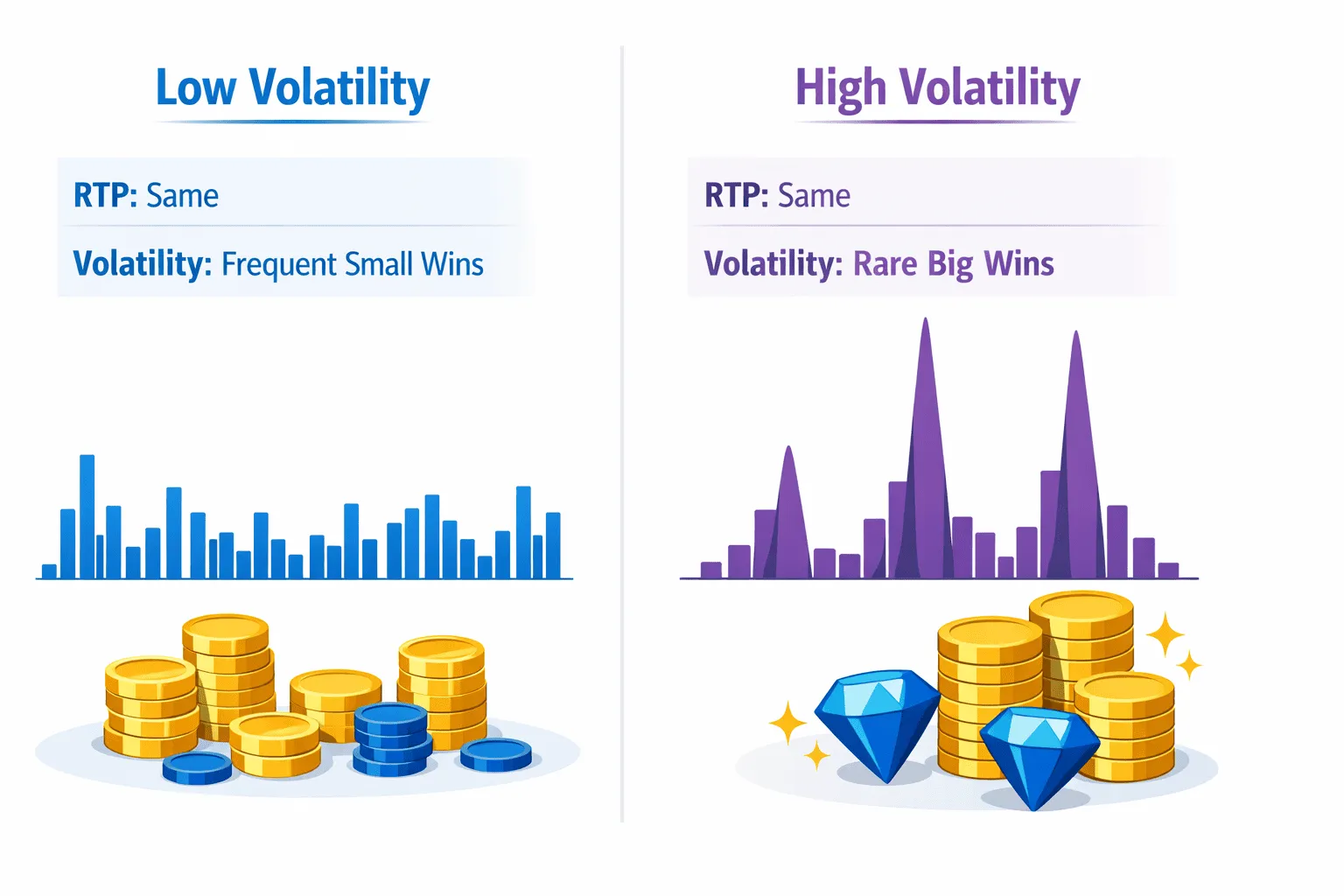
Both slots might have the exact same 96% RTP. The amount returned to the pool of players is the same, but the distribution of that money is completely different.
One psychology concept that helps explain why “unpredictable rewards” keep people spinning is the variable-ratio reinforcement schedule (commonly discussed in learning/behavior psychology). For an iGaming-focused look at how casinos (and casino games) are designed to keep you engaged, see the psychology of gambling: why casinos feel so engaging. For a clear overview, read: Schedules of reinforcement (including variable-ratio and gambling).
How to Choose Based on Your Budget
This is where the strategy comes in. Your bankroll size should dictate the volatility you choose, not just the theme of the game. If you want to go one level deeper on protecting your bankroll (and reducing avoidable mistakes), read our guide on risk management in gambling.

Scenario 1: The “Entertainment” Budget (Low Bankroll)
Profile: You have $20 or $50. You want to play for an hour or two, enjoy the graphics, and maybe leave with a small profit.
- Choose: Low Volatility / High RTP.
- Why: High volatility slots can eat a small bankroll in minutes during a dry spell. Low volatility games keep your balance ticking over, giving you more play time.
- Recommended RTP: Look for 96.5% or higher.
Scenario 2: The “Jackpot Hunter” (High Bankroll)
Profile: You have a larger budget ($200+). You are okay with losing it all for the chance to win a 5,000x or 10,000x jackpot.
- Choose: High Volatility.
- Why: You have the financial cushion to weather the “dead spins.” You are essentially paying for the opportunity to trigger a high-paying bonus round.
- Warning: High RTP is still good here, but volatility is the more critical factor for the type of win you want.
Scenario 3: The Bonus Hunter
Profile: You are trying to clear a casino bonus wagering requirement.
- Choose: Low Volatility.
- Why: You need to turnover money without losing your principal. Low variance slots reduce the risk of busting out before you meet the wagering terms.
How to Find This Information
Casinos don’t always plaster volatility ratings on the front page, but you can find them:
- The Paytable: Open the game’s info screen. Look for the payout structure. If 5 symbols pay only slightly more than 3 symbols, it’s likely low volatility. If 5 symbols pay massive amounts compared to 3, it’s likely high volatility.
- Developer Websites: Providers like NetEnt, Pragmatic Play, and Play’n GO usually list the volatility rating (e.g., 5/5 lightning bolts) on their official product sheets.
- Google Search: Simply search “[Slot Name] RTP and Volatility.”
Conclusion: Match the Math to Your Style
Winning at slots is never guaranteed; the house always has an edge. However, you can control the quality of your session.
Don’t play a high-volatility “Book of Dead” style game if you only have $20 and want to play for an hour. Conversely, don’t play a low-volatility “Starburst” style game if you are chasing a life-changing win. If you want more practical, player-first advice, see our guide on slots strategy and tips.
Check the RTP to ensure you aren’t getting a bad deal (avoid anything under 94%), and pick the volatility that respects your wallet.
Responsible Gambling Warning: Gambling involves risk. No strategy, including analyzing RTP or volatility, can guarantee a win. Never gamble with money you cannot afford to lose. If you or someone you know has a gambling problem, seek help from organizations like BeGambleAware or local support services. You can also read our responsible gambling guide: limits, risks & safety tips.
For free, confidential help in the U.S., you can also contact the National Council on Problem Gambling and the National Problem Gambling Helpline (1-800-522-4700): Get help and support resources.
Related guides
Knowledge Base-
Live Dealer vs. RNG Blackjack: Odds, Speed, and Strategy Compared
Compare Live Dealer vs. RNG Blackjack to find the best odds and speed. Discover how gameplay style, fairness, and strategy differ in this expert guide.
Knowledge Base
-
Data-Driven Bankroll Management: Using the Kelly Criterion in Online Casinos
Master data-driven bankroll management with the Kelly Criterion. Learn how to optimize bet sizing, manage risk, and maximize growth in online casinos.
Knowledge Base
-
How to Clear Wagering Requirements: A Low-Volatility Strategy Guide
Unlock your casino bonus with our low-volatility strategy. Learn to clear wagering requirements using high RTP slots and smart risk management to keep your winnings.
Knowledge Base