
Understanding Casino Odds, RTP & House Edge
Learn the significance of casino odds, RTP, and house edge to make informed gaming decisions and understand your cost of play.
Every time you step onto a casino floor or log into an online gaming site, you are engaging with a mathematical system designed to generate a profit for the operator. While luck plays the central role in the short term, the long-term results are governed by three critical concepts: Odds, Return to Player (RTP), and House Edge.

Understanding these metrics is not about finding a “winning system” – which doesn’t exist – but about understanding the cost of play and making informed choices. This guide breaks down the mathematics behind the most popular casino games, helping you distinguish between high-risk bets and those that offer better statistical value.
The Core Concepts: What Are You Actually Betting On?
Before diving into specific games, we must define the terminology that governs casino mathematics. These terms are often used interchangeably, but they represent different aspects of the gaming model.
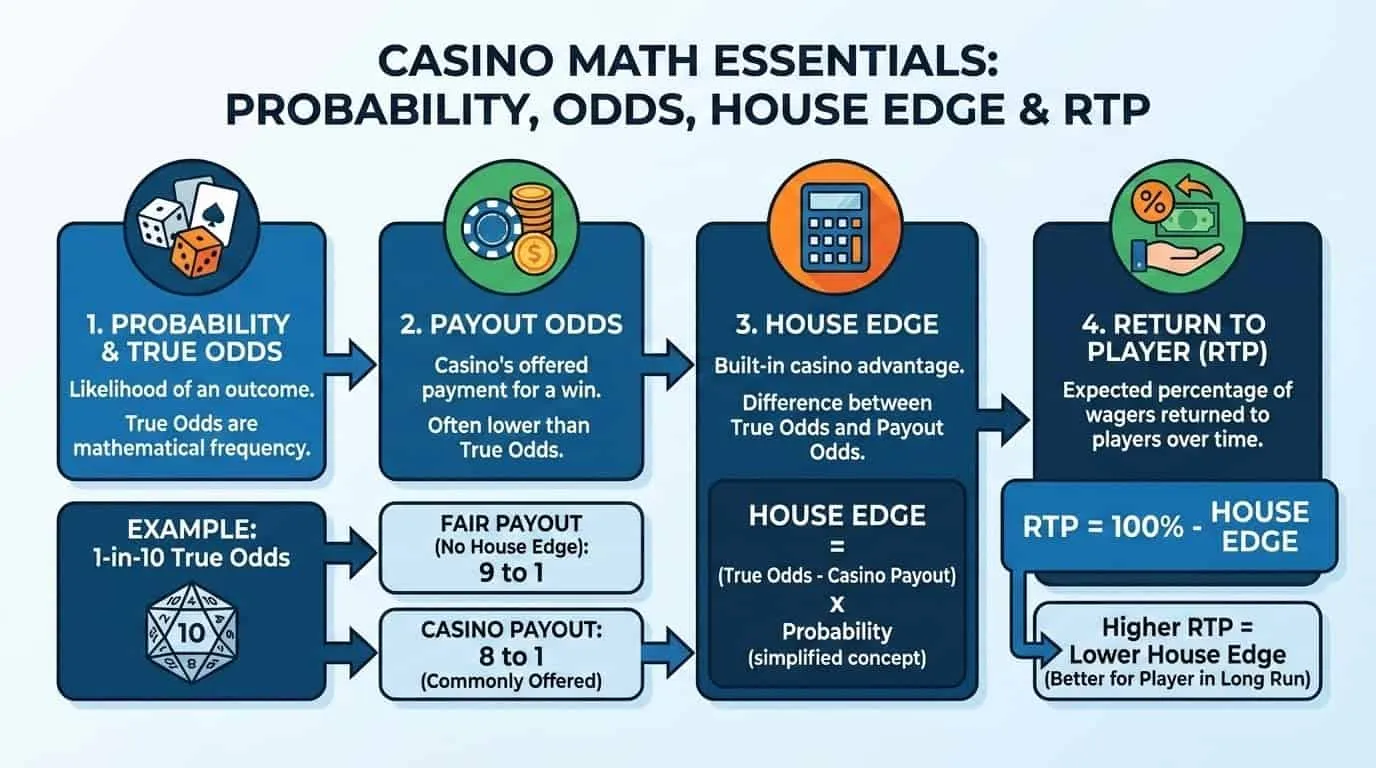
1. Probability vs. Odds
Probability is the mathematical likelihood that a specific event will occur, usually expressed as a percentage. For example, the probability of flipping a coin and getting heads is 50%.
Odds generally refer to the ratio between the amount staked and the amount won. In a casino context, “True Odds” are the actual statistical likelihood of winning, while “Payout Odds” are what the casino pays you. The difference between these two figures is where the casino makes its money.
Key Takeaway: If a bet has a 1 in 10 chance of winning (True Odds), a fair payout would be 9 to 1. However, the casino might only pay 8 to 1. This discrepancy creates the House Edge.
2. The House Edge
The House Edge is the mathematical advantage that the gambling game, and thus the commercial gambling venue, has over you as you play over time. It is expressed as a percentage of your original bet.
- If a game has a 5% House Edge, the casino expects to keep $5 for every $100 wagered on average over the long run.
- This does not mean you will lose $5 every time. You might win $1,000 or lose $100 in a single session. The House Edge realizes itself over thousands of hands or spins.
Want more practical, real-world ways to reduce unnecessary risk while you play? See our guide on risk management in gambling.
3. Return to Player (RTP)
RTP is the flip side of the House Edge. It represents the percentage of all the wagered money a slot machine or casino game will pay back to players over time. Read more about how RTP works (and why it’s measured over very large samples) in the UK Gambling Commission’s player guide: Return to player: how much gaming machines payout.
- Formula: 100% – House Edge = RTP
- Example: A slot machine with a 96% RTP keeps 4% (House Edge) and returns 96% to players as winnings.
Game-by-Game Analysis
Different games offer vastly different odds. Games of pure chance, like slots and roulette, have a fixed House Edge. Games of skill, like Blackjack and Poker, allow players to influence the outcome to a degree.
1. Online and Land-Based Slots
Slots are the most popular casino games, primarily because they are easy to play. However, they are often the most opaque regarding odds.
Understanding Slot RTP and Volatility
Unlike table games, you cannot calculate the odds of a slot machine simply by looking at it. You must rely on the published RTP.
- Average RTP: Online slots typically range from 94% to 98%. Land-based slot machines often have lower RTPs (sometimes as low as 85% to 90%) due to higher overhead costs.
- Volatility (Variance): This measures the risk. A high volatility slot pays out less frequently but offers larger sums (high risk, high reward). A low volatility slot pays out smaller amounts more frequently.
If you want a more actionable breakdown of slot odds, RTP, and common misconceptions, read: Slots strategy and tips: how do you improve your chances of winning at slots?
Note on RNGs: All legitimate slots use a Random Number Generator (RNG). Every spin is independent. A machine is never “due” for a win.
2. Roulette: The Zero Makes the Difference
Roulette is a perfect example of how a small rule change can drastically alter the House Edge.
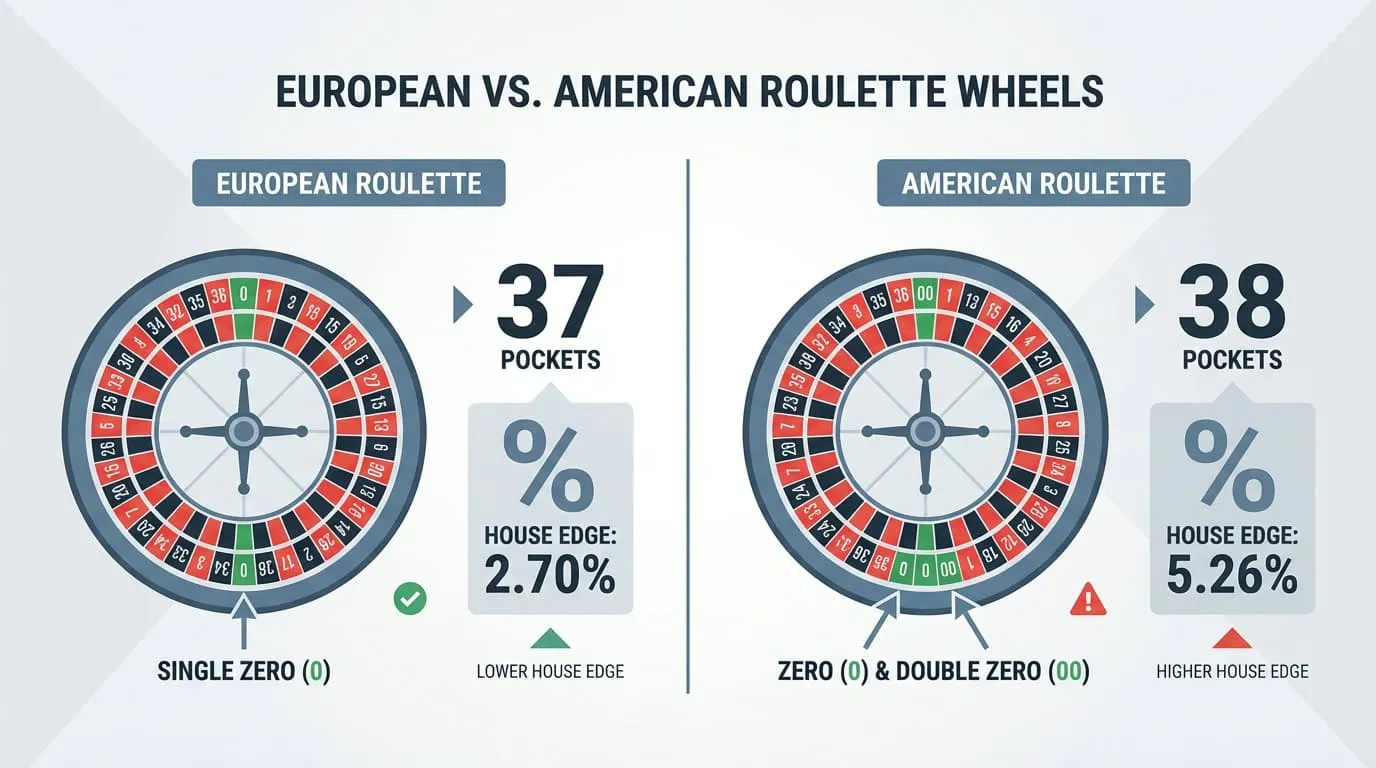
European vs. American Roulette
| Game Type | Wheel Layout | House Edge |
|---|---|---|
| European Roulette | Numbers 1-36 plus one Zero (0) | 2.70% |
| American Roulette | Numbers 1-36 plus Zero (0) and Double Zero (00) | 5.26% |
In American Roulette, the addition of the “00” increases the total numbers to 38, but the payout for a straight-up win remains 35 to 1. This significantly dilutes your odds. European Roulette is statistically superior for the player.
3. Blackjack: Where Strategy Matters
Blackjack is unique because the House Edge is not fixed; it fluctuates based on how well you play. It offers some of the best odds in the casino if played correctly.
- The Unskilled Player: A player guessing or playing by “gut feeling” faces a House Edge of roughly 2% to 4%.
- Basic Strategy: By following a mathematically perfect strategy chart (knowing exactly when to hit, stand, split, or double down), you can reduce the House Edge to roughly 0.5%.
The rules of the specific table also impact the edge. Look for tables that pay 3:2 for a Blackjack rather than 6:5. A 6:5 payout increases the House Edge by nearly 1.4%, making it a much worse bet.
4. Poker: Player vs. Player vs. House
Poker falls into two distinct categories regarding odds.
Video Poker & Casino Hold’em (Player vs. House)
Like Blackjack, Video Poker involves skill. In variants like “Jacks or Better,” optimal play can result in an extremely high RTP, sometimes exceeding 99%. However, mistakes are costly and increase the House Edge rapidly.
Texas Hold’em (Player vs. Player)
In traditional poker rooms, you are not playing against the house. You play against other players. The casino takes a small percentage of the pot, known as the Rake. Here, there is no “House Edge” in the traditional sense; your success depends entirely on your skill relative to your opponents.
The Gambler’s Fallacy
One of the biggest pitfalls for players is the Gambler’s Fallacy—the belief that past events influence future outcomes in independent trials. For a deeper explanation of why people fall into this thinking trap (especially in games like roulette), see: Gambler’s fallacy.
For a casino-focused explanation (and examples you’ll recognize from real play), read: What is the Gambler’s Fallacy? You can also explore the closely related concept known as the Fallacy of the Maturity of Chances.
Example: “The roulette ball has landed on Red five times in a row; Black is bound to hit next.”
The Reality: The wheel has no memory. The odds of landing on Red or Black remain exactly the same for every spin, regardless of history.
Conclusion: Responsible Gaming
Understanding RTP and House Edge does not guarantee a win. The math ensures that the casino always has the advantage in the long run. These metrics should be used to manage your bankroll and extend your playtime, not as a roadmap to income.
Always gamble responsibly. Set a budget before you play, never chase losses, and view casino gaming strictly as a form of entertainment, paying for the experience much like you would a movie ticket or a nice dinner. For practical, player-friendly responsible gaming guidelines, read Responsible Play (Have A Game Plan), and for support resources (including the U.S. National Problem Gambling Helpline), visit the National Council on Problem Gambling help and treatment page.
If you’re looking for more general guidance before choosing where to play, browse our overview of online casinos.
Related guides
Knowledge Base-
Live Dealer vs. RNG Blackjack: Odds, Speed, and Strategy Compared
Compare Live Dealer vs. RNG Blackjack to find the best odds and speed. Discover how gameplay style, fairness, and strategy differ in this expert guide.
Knowledge Base
-
RTP vs. Volatility: How to Choose the Right Slot for Your Budget
Learn the difference between RTP and volatility in slots. Discover how to choose the right game to maximize your playtime and match your budget.
Knowledge Base
-
Data-Driven Bankroll Management: Using the Kelly Criterion in Online Casinos
Master data-driven bankroll management with the Kelly Criterion. Learn how to optimize bet sizing, manage risk, and maximize growth in online casinos.
Knowledge Base