
Why Gambling Systems Fail Over Time: The Mathematics of the House Edge
Discover why betting systems like Martingale fail long-term. We break down the house edge, gambler's fallacy, and the math casinos rely on for profit.
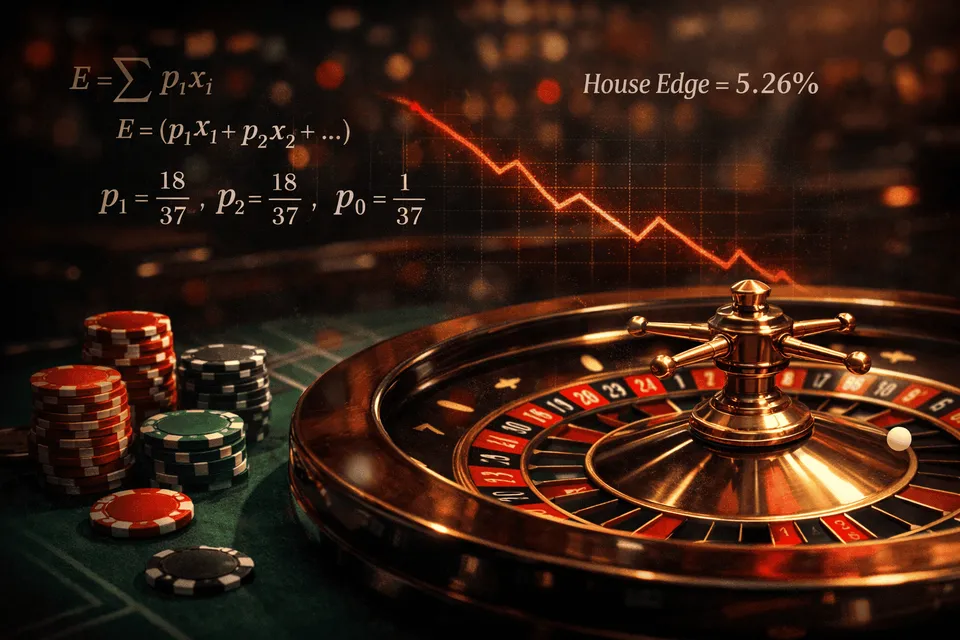
The allure of beating the casino is as old as the games themselves. For centuries, players have devised intricate betting strategies, mathematical progressions, and “foolproof” systems designed to overcome the odds. From the glitzy floors of Las Vegas to online platforms, the promise is always the same: a structured way to guarantee profit.

However, the reality is starkly different. While short-term variance can make anyone look like a genius, the long-term mathematical reality is undefeated. Gambling systems fail over time not because players aren’t disciplined enough, but because of the fundamental design of casino games.
This article breaks down the mathematics behind why betting systems crumble, analyzes popular strategies like the Martingale, and explains why the house edge is an insurmountable wall over the long run. If you want a broader framework for playing smarter (without believing in “guaranteed” wins), see our overview of proven gambling strategies.
The Immutable Law: The House Edge
To understand why systems fail, you must first understand the environment in which they operate. Every casino game (with the rare exception of card counting in blackjack or advantage play in poker) is designed with a mathematical advantage for the casino, known as the House Edge.
The house edge is the difference between the true odds of an event occurring and the odds the casino pays you for it. This gap ensures that, over time, the casino retains a percentage of every wager placed.
The Roulette Example
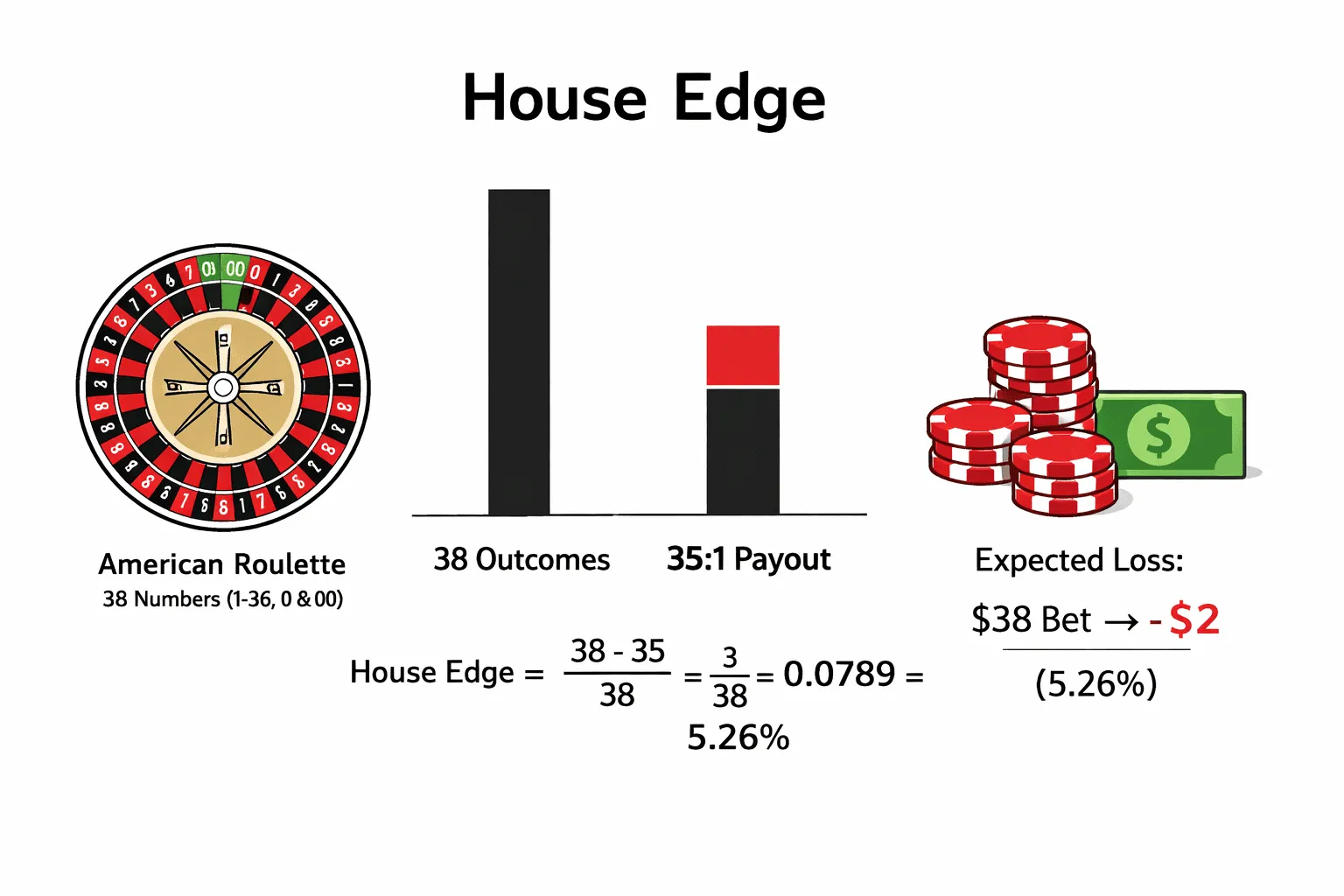
Consider American Roulette. There are 38 numbers on the wheel (1–36, 0, and 00).
- True Odds: The chance of hitting a specific number is 1 in 38.
- Casino Payout: The casino pays 35 to 1.
If you bet $1 on every number, you would spend $38. When the ball lands, you would win back $35 plus your original $1 stake, totaling $36. You have lost $2. That built-in discrepancy is the house edge (5.26% in American Roulette), and no amount of manipulating your bet size can change these underlying probabilities. Read a clear breakdown of how roulette house edge is calculated at Wizard of Odds.
The Psychology Trap: The Gambler’s Fallacy
Many betting systems rely on a flawed psychological concept known as the Gambler’s Fallacy. This is the mistaken belief that if a particular event occurs more frequently than normal during the past, it is less likely to happen in the future (or vice versa). For a dedicated explanation and examples, read our guide on what the gambler’s fallacy is.
For example, if a roulette wheel hits “Red” five times in a row, a system player might bet heavily on “Black,” believing it is “due.”
The Mathematical Reality: Roulette wheels, dice, and slot machines have no memory. Every spin or roll is an independent event. The odds of hitting Red on the sixth spin are exactly the same as the first spin: 47.4% (in American Roulette). Systems that predicate their bets on “streaks” or “balancing out” are mathematically baseless in the short term. If you want a deeper explanation of why our brains misread randomness, see Britannica’s discussion of the law of large numbers and how it’s often confused with “the law of averages.”
Breakdown of Popular Betting Systems
Despite the math, players flock to structured betting systems. Here is why the most popular ones eventually collapse.
1. The Martingale System
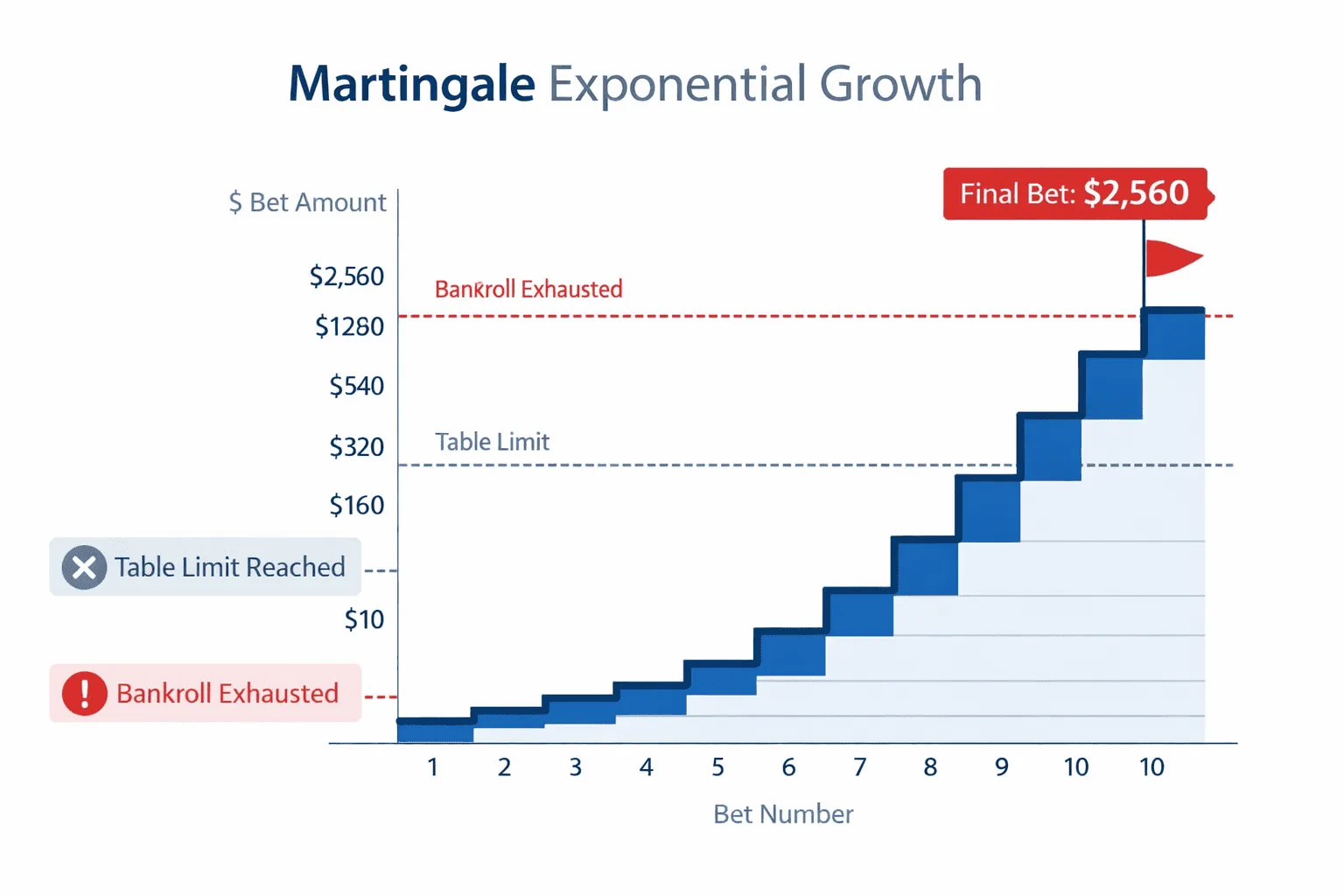
The most famous of all betting strategies, the Martingale, advises players to double their bet after every loss. The theory is that eventually, a win will occur, covering all previous losses and providing a profit equal to the original stake. (If you want the full mechanics and variations, see our in-depth breakdown of the Martingale system.)
Why It Fails:
- Exponential Growth: Doubling numbers grow terrifyingly fast. Starting with a $5 bet, a losing streak of just 9 hands means your 10th wager has to be $2,560 to win back a mere $5.
- Table Limits: Casinos impose maximum bet limits specifically to break Martingale players. Once you hit the table limit (e.g., $5,000), you are statistically forbidden from doubling again to recoup your losses.
- Bankroll Exhaustion: Even if there were no table limits, no player has an infinite bankroll to sustain an infinite losing streak.
2. The Paroli System (Reverse Martingale)
The Paroli is a positive progression system where you double your bet after a win, hoping to ride a “hot streak.” It is considered safer than the Martingale because you are not chasing losses with your own capital, but rather using house money.
Why It Fails:
While safer, the Paroli fails to overcome the house edge. It relies on streaks of three wins in a row to generate significant profit. However, the probability of winning three independent events in a row (at slightly less than 50% odds each) is low. Over time, the cumulative small losses from failed streaks erode the bankroll faster than the rare big win replenishes it.
3. The D’Alembert System
Based on the theory of equilibrium, this system involves increasing your bet by one unit after a loss and decreasing it by one unit after a win. It assumes that wins and losses will eventually equal out. If you’re curious about related progression approaches, you may also like our guide to the Contra d’Alembert betting system.
Why It Fails:
The D’Alembert falls victim to the Gambler’s Fallacy. Just because you have lost more than you have won recently does not mean the universe owes you a win to create equilibrium. Furthermore, the house edge guarantees that even if wins and losses were equal, you would still lose money due to the “0” and “00” (in roulette) or the vigorish (in sports betting).
4. The Fibonacci System
This system uses the famous Fibonacci sequence (1, 1, 2, 3, 5, 8, 13…) to determine bet sizes. You move up the sequence after a loss and down two steps after a win.
Why It Fails:
Like the Martingale, this is a negative progression system. While the bets don’t ramp up as quickly as doubling, a prolonged losing streak will still result in large wagers chasing small profits. It merely delays the inevitable bust-out rather than preventing it.
The Law of Large Numbers: Why Math Always Wins
If you play for ten minutes, you might win. This is called Variance. In the short term, anything can happen, and luck plays a massive role.
However, casinos don’t operate in the short term. They operate on the Law of Large Numbers. This theorem states that as the number of trials (bets) increases, the actual results will converge on the expected value (the mathematical probability). For a plain-English definition with gambling context, see Britannica’s overview of the law of large numbers.
The longer you play, and the more you use a system to extend your playtime, the more you expose your bankroll to the house edge. A system might help you manage your money or make the game more exciting, but it cannot alter the game’s payout percentage (RTP). For practical bankroll and session tips, read our guide on risk management in gambling.
The Flaw of “Bet Sizing”
The fatal flaw in almost every gambling system is the belief that how much you bet changes the odds of the bet.
It does not.
Whether you bet $5 or $5,000, your chance of winning a hand of Blackjack or a spin of Roulette remains constant. Changing the bet size only changes the volatility of your bankroll, not the probability of the outcome.
Conclusion: Systems are for Entertainment, Not Profit
Understanding why gambling systems fail is crucial for responsible gaming. There is no magic formula, no secret pattern, and no betting progression that can mathematically overcome a negative expectation game.
Systems can be fun. They can provide structure to your gambling and prevent you from betting your entire bankroll on a single hand. However, they should be viewed as a form of entertainment expense, not an investment strategy. In the long run, the house edge is an omnipresent tax on every wager, ensuring that while individual players may win, the house never loses.
Disclaimer: Gambling involves risk. The information provided in this article is for educational purposes only and does not constitute financial advice. If you or someone you know has a gambling problem, please seek help from professional organizations.
Need confidential support? The National Council on Problem Gambling offers help, including the National Problem Gambling Helpline (call/text/chat options) and state-by-state resources.
Related guides
Knowledge Base-
Live Dealer vs. RNG Blackjack: Odds, Speed, and Strategy Compared
Compare Live Dealer vs. RNG Blackjack to find the best odds and speed. Discover how gameplay style, fairness, and strategy differ in this expert guide.
Knowledge Base
-
RTP vs. Volatility: How to Choose the Right Slot for Your Budget
Learn the difference between RTP and volatility in slots. Discover how to choose the right game to maximize your playtime and match your budget.
Knowledge Base
-
Data-Driven Bankroll Management: Using the Kelly Criterion in Online Casinos
Master data-driven bankroll management with the Kelly Criterion. Learn how to optimize bet sizing, manage risk, and maximize growth in online casinos.
Knowledge Base