
Slots vs. Table Games: A Realistic Guide to Risk, Skill, and Expectations
Explore the differences between slots and table games to make informed gambling choices and manage your expectations effectively.
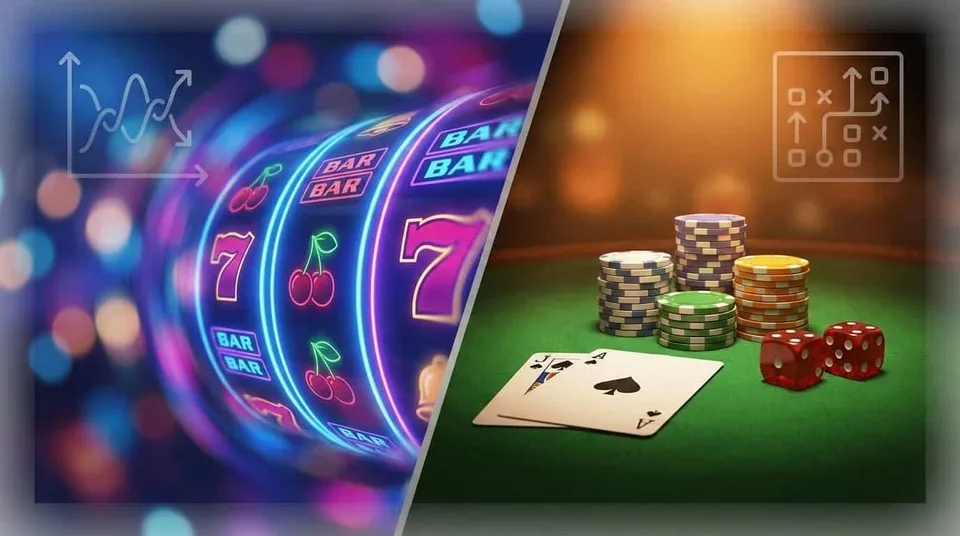
Walk into any casino, online or land-based, and you are immediately presented with a choice that defines your gambling experience. On one side, the flashing lights and immersive themes of slot machines promise life-changing jackpots for the price of a spin. On the other, the green felt of table games offers a more tactical, social experience where strategy seems to influence the outcome.

For players, the debate of Slots vs Table Games isn’t just about preference; it is a fundamental question of risk tolerance, control, and mathematical expectation. This guide breaks down the mechanics behind both to help you decide which aligns with your goals. If you’re still exploring where to play, you can start with our overview of online casinos.
The Core Difference: RNG vs. Human Element
To understand the odds, you must first understand the engine driving the game.
Slots: The Realm of Pure Chance
Modern slot machines are powered by a Random Number Generator (RNG). This algorithm cycles through millions of number combinations every second. The moment you press “spin,” the outcome is frozen. No amount of “stopping the reels” or betting patterns can alter the result. (If you want a deeper, plain-English explainer of randomness and how random-number generation works, read more here.)
- Control: Near Zero. You control your bet size and machine choice, nothing else.
- Speed: Extremely fast. Players can easily execute 500+ spins per hour.
- Barrier to Entry: Low. No knowledge is required to play.
If you want practical ways to approach slots (without falling for myths), see our guide on slots strategy and tips.
Table Games: Strategy and Probability
Table games like Blackjack, Poker, and Craps involve physical elements—cards, dice, wheels—and rigid mathematical probabilities. While luck is the dominant factor, optimal strategy can mathematically reduce the house edge.
- Control: Moderate. Your decisions (hit, stand, raise, fold) directly impact the outcome.
- Speed: Slower. The pace is dictated by the dealer and other players (approx. 50-100 hands per hour).
- Barrier to Entry: Moderate to High. Rules and etiquette must be learned.
House Edge and Return to Player (RTP)
The “House Edge” is the mathematical advantage the casino holds over the player, expressed as a percentage of your bet that the casino expects to keep over the long term.
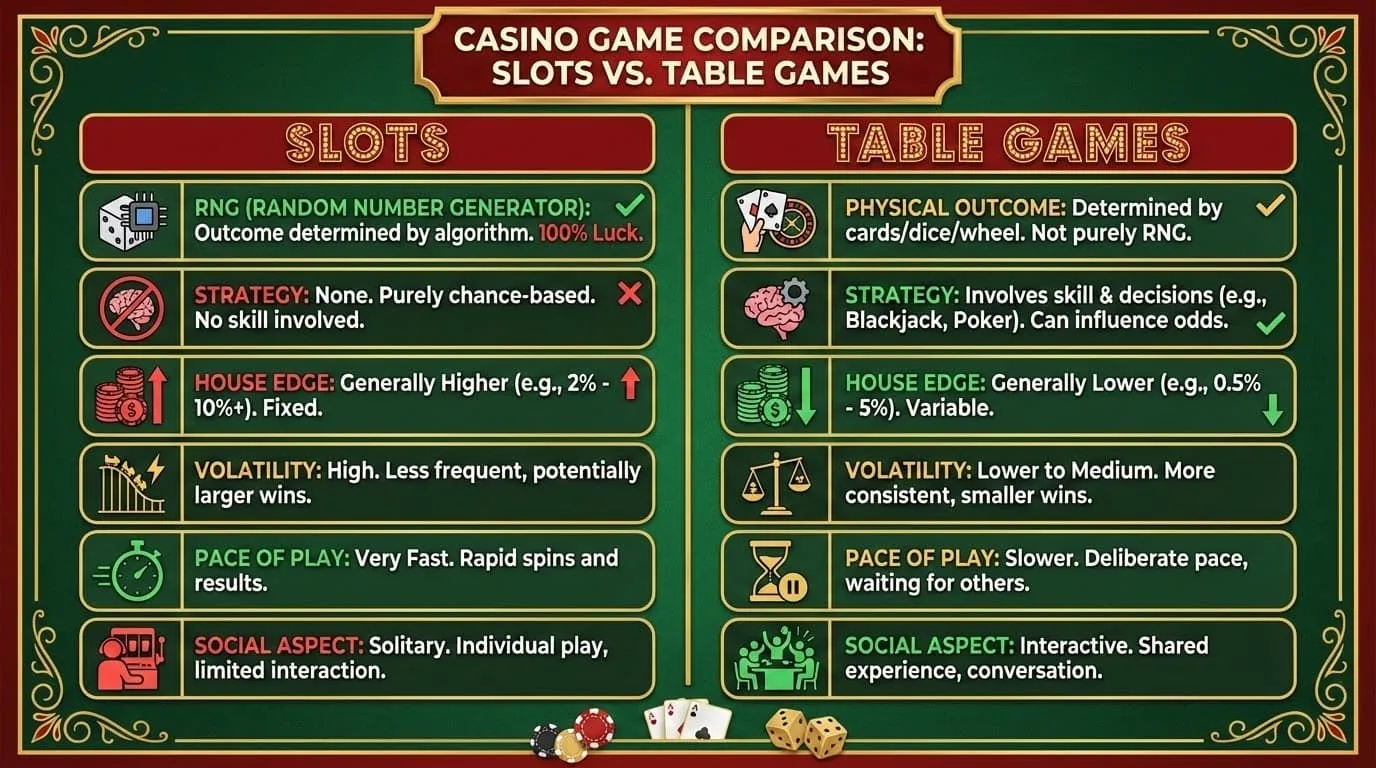
The Cost of Slots
Slots generally have a higher house edge than table games. This is the “price” you pay for the potential of a massive jackpot payout.
- Average House Edge: 2% to 15% (RTP of 85% to 98%).
- Reality: You are likely to lose your bankroll faster on slots due to the combination of a higher edge and faster speed of play.
The Odds of the Tables
Table games are statistically friendlier to the player’s bankroll, provided you know what you are doing.
- Blackjack (with Basic Strategy): ~0.5% House Edge.
- Baccarat (Banker Bet): ~1.06% House Edge.
- European Roulette: 2.7% House Edge.
- Craps (Pass Line): 1.41% House Edge.
Key Takeaway: If your goal is to extend your playtime and minimize losses, table games are mathematically superior.
Volatility: The Rollercoaster vs. The Grind
Volatility (or variance) describes how a game pays out. This is crucial for managing your expectations and your bankroll.
Slots: High Volatility
Slots are typically high-volatility beasts. You might spin for 20 minutes with zero returns, draining your funds, only to hit a bonus round that pays 500x your bet. The experience is “all or nothing.” This variance makes slots exciting but dangerous for a small bankroll.
Table Games: Low to Medium Volatility
Table games offer a steadier experience. In Blackjack or Baccarat, you win close to 50% of your hands (excluding ties). You essentially trade wins and losses back and forth with the casino. While you rarely win 1,000x your bet in a single hand, you are also less likely to lose your entire budget in 10 minutes.

The Skill Factor: Illusion or Reality?
Can you beat the house? This is where the divide between slots and tables is widest.
In slots, skill is non-existent. “Hot” and “cold” machines are a myth born of the Gambler’s Fallacy. The odds on the next spin are always identical to the previous one. If you want a more detailed breakdown of this concept, read our guide on what the Gambler’s Fallacy is (and why it trips players up).
In table games, skill is a tool for damage control. In Blackjack, memorizing a basic strategy chart prevents you from making statistically poor decisions. In Poker, skill is dominant because you are playing against other players, not the house; however, the casino still takes a “rake” (a fee).
Comparison Summary
| Feature | Slots | Table Games |
|---|---|---|
| Primary Driver | Luck (RNG) | Luck + Strategy |
| House Edge | High (2% – 15%) | Low (0.5% – 5%) |
| Volatility | High (Jackpot potential) | Low (Steady play) |
| Pace of Play | Very Fast | Slow to Moderate |
| Social Aspect | Low (Solitary) | High (Interactive) |
Verdict: Which Should You Choose?
The “better” game depends entirely on what you want from your casino session.
Choose Slots If:
- You play for the thrill of a potential life-changing win.
- You prefer solitary play and want to avoid social pressure.
- You do not want to memorize rules or strategies.
- You have a budget you are comfortable losing quickly for entertainment.
Choose Table Games If:
- You want the best statistical odds of winning (or losing less).
- You enjoy social interaction and the atmosphere of the pit.
- You enjoy using your brain and feeling like your decisions matter.
- You want your bankroll to last as long as possible.
Ultimately, the house always has the advantage in the long run. Whether you choose the mesmerizing spin of the reels or the tactical grit of the blackjack table, the most important skill is responsible bankroll management. For deeper guidance on protecting your budget and making smarter decisions, see our article on risk management in gambling and our roundup of proven gambling strategies (with realistic expectations).
For practical, player-first guidance on setting limits and keeping gambling recreational, see the National Council on Problem Gambling’s Responsible Play tips here. If gambling stops feeling fun or starts feeling hard to control, it may help to learn about treatment options and support approaches for compulsive gambling from a clinical perspective (read Mayo Clinic’s overview here).
Related guides
Knowledge Base-
Live Dealer vs. RNG Blackjack: Odds, Speed, and Strategy Compared
Compare Live Dealer vs. RNG Blackjack to find the best odds and speed. Discover how gameplay style, fairness, and strategy differ in this expert guide.
Knowledge Base
-
RTP vs. Volatility: How to Choose the Right Slot for Your Budget
Learn the difference between RTP and volatility in slots. Discover how to choose the right game to maximize your playtime and match your budget.
Knowledge Base
-
Data-Driven Bankroll Management: Using the Kelly Criterion in Online Casinos
Master data-driven bankroll management with the Kelly Criterion. Learn how to optimize bet sizing, manage risk, and maximize growth in online casinos.
Knowledge Base